
Jump to content
  • articles
    9,839
  • comments
    83
  • views
    12,457,764

Contributors to this article

About this News

Articles in the news


Call for action following latest 'Never Events' report

The Association for Perioperative Practice (AfPP) is calling for action to be taken after a recent report suggests little progress has been made to prevent errors within the perioperative environment.

The patient safety charity made the call following the release of NHS Improvement’s latest Never Event report; Provisional publication of Never Events reported as occurring between 1 April and 31 December 2019, which revealed an alarming 81% (284) of the never events recorded happened while a patient was on the operating table.

Lindsay Keeley, patient safety and quality lead at AfPP said: “The survey highlighted that there’s a need to take action now if we are to support the healthcare profession in reducing the occurrence of never events. It has become clear that receptive team culture, a strong leadership team and better support for staff is what will help to reduce the risk of a never event occurring. It’s vital that those in leadership positions begin to understand the contributory factors in the recurrence of never events and the challenges faced by staff."

She went on to highlight some of the recent initiative taking place: “What is promising is that there are practitioners who are developing new, practical and simple solutions every day that can support other team members and can be used within theatres across the country."

"One example is Rob Tomlinson’s introduction of the 10,000 Feet initiative – a safety initiative designed to cut through noise and distraction within the theatre environment, particularly at critical points of the patient’s journey. If correctly implemented, initiatives like this can cut through the hierarchies that stop people feeling unable to speak up when they see something that shouldn’t be happening, thus reducing the occurrence of never events"

“We of course need to be mindful that there will always be challenges within perioperative practice in the form of interruptions and distractions, but the key is how as practitioners we engage with this to recognise and reduce never events.”

Read full story

Source: Clinical Services Journal, 25 February 2020
Read more
 

Coronavirus reveals limits of AI health tools

Technology and healthcare companies are racing to roll out new tools to test for and eventually treat the coronavirus epidemic spreading around the world. But one sector that is holding back are the makers of artificial-intelligence-enabled diagnostic tools, increasingly championed by companies, healthcare systems and governments as a substitute for routine doctor-office visits.

In theory, such tools, sometimes called “symptom checkers” or healthcare bots,sound like an obvious short-term fix: they could be used to help assess whether someone has Covid-19, the illness caused by the novel coronavirus, while keeping infected people away from crowded doctor’s offices or emergency rooms where they might spread it.

These tools vary in sophistication. Some use a relatively simple process, like a decision tree, to provide online advice for basic health issues. Other services say they use more advanced technology, like algorithms based on machine learning, that can diagnose problems more precisely.

But some digital-health companies that make such tools say they are wary of updating their algorithms to incorporate questions about the new coronavirus strain. Their hesitancy highlights both how little is known about the spread of Covid-19 and the broader limitations of healthcare technologies marketed as AI in the face of novel, fast-spreading illnesses.

Some companies say they don’t have enough data about the new coronavirus to plug into their existing products. London-based symptom-checking app Your.MD Ltd. recently added a “coronavirus checker” button that leads to a series of questions about symptoms. But it is based on a simple decision tree. The company said it won’t update the more sophisticated technology underpinning its main system, which is based on machine learning.

“We made a decision not to do it through the AI because we haven’t got the underlying science,” said Maureen Baker, Chief Medical Officer for Your.MD. She said it could take 6 to 12 months before sufficient peer-reviewed scientific literature becomes available to help inform the redesign of algorithms used in today’s more advanced symptom checkers.

Read full story

Source: The Wall Street Journal, 29 February 2020

Read more
 

Infant mortality rate in Northern Ireland is the worst in the UK, report finds

Northern Ireland's infant mortality rate remains the highest of any UK region although it has decreased, according to a new report.

Infant mortality is a measure of deaths of children under one year of age. The report from the Royal College of Paediatrics and Child Health (RCPCH) shows the current rate is 4.2 deaths per 1,000 live births. In 2017, the figure stood at 4.8 deaths.

Infant mortality rates decreased in Northern Ireland, Scotland and Wales but remained unchanged in England, which has the second highest rate of 3.9 deaths per 1,000.

The report also highlights an increase in the suicide rate among young people aged 15–24 years.

Responding to the figures, Health Minister Robin Swann said the physical and mental health of children and young people was a "priority" for the for the Northern Ireland Executive.

"My department is already investing in a number of programmes and strategies which seek to address child health inequalities and improve the wellbeing of our children."

Dr Ray Nethercott, RCPCH officer for Ireland acknowledged the current healthcare crisis as well as concerns about waiting lists and standard of care but added that "children's health and wellbeing should not be seen as being in competition with adult services or health provision".

"Acting early to treat and prevent conditions, and reducing the impact of factors such as poverty, can really improve health outcomes. A healthier population of children and young people will reduce many of the pressures on adult services in the long term."

Read full story

Source: BBC News, 4 March 2020

Read more
 

Neglect and serious failings contributed to death of vulnerable man in removal centre, inquest finds

Neglect and serious failures by the Home Office and multiple other agencies contributed to the death of a vulnerable man who died from hypothermia, dehydration and malnutrition in an immigration removal centre, an inquest has found.

Prince Fosu, a 31-year-old Ghanaian national, died in October 2012 when his naked body was found on the concrete floor of his cell in Harmondsworth, a detention centre near Heathrow. He had been experiencing a psychotic episode but he was not referred for a mental health assessment due to “gross failures” by all agencies to recognise the need to provide appropriate care to a person unable to look after himself.

Four GPs, two nurses, two Home Office contract monitors, three members of the Independent Monitoring Board (IMB) and countless detention custody officers and managers who visited him failed to take any meaningful steps, the inquest found.

Three doctors have since been referred to the UK’s medical watchdog for their alleged failures relating to the death of Mr Fosu on recommendation of the Prison and Probation Ombudsman (PPO), who said the care he received fell “considerably below acceptable standards”.

Read full story

Source: The Independent, 3 March 2020

Read more
 

Women in labour being refused epidurals, official inquiry finds

Women in labour are being refused epidurals in breach of official guidelines, a government inquiry has found.

In findings reported by the Guardian, an investigation by the Department of Health and Social Care also found that women may not be being kept fully informed that if they choose to give birth at home or in a midwife-led unit they may have to be transferred if they want an epidural. Failing to make women aware of that possibility would also be in breach of National Institute for Health and Care Excellence (NICE) guidelines.

As a result of the inquiry, the Health Minister Nadine Dorries will write to all heads and directors of midwifery and medical directors at NHS trusts this week to remind them of the NICE guidance regarding pain relief during childbirth and to ensure it is being followed.

Clare Murphy, Director of external affairs at the British Pregnancy Advisory Service, said the “results of the government’s inquiry are sadly not surprising”. She added: “We have spoken with many women who have been so traumatised by their experience of childbirth that they are considering ending what would otherwise be wanted pregnancies. Pain relief is sometimes treated as a ‘nice extra’ rather than an integral part of maternity care, and women and their families can suffer profoundly as a result."

Read full story

Source: Guardian, 3 March 2020

Read more
 

Woman was left with PTSD after routine NHS medical check caused pain worse than childbirth

Every week for nearly a year, Lorraine Shilcock attended an hour-long counselling session paid for by the NHS.

She needed the therapy, which ended in November, to cope with the terrifying nightmares that would wake her five or six times a night, and the haunting daytime flashbacks. Lorraine, 67, a retired textile worker from Desford, Leicester, has post-traumatic stress disorder (PTSD). Her psychological scars due to a routine NHS medical check, which was supposed to help her, not leave her suffering.

In October 2018, Lorraine had a hysteroscopy, a common procedure to inspect the womb in women who have heavy or abnormal bleeding. The 30-minute procedure, performed in an outpatient clinic, is considered so routine that many women are told it will be no worse than a smear test and that, if they are worried about the pain, they can take a couple of paracetamol or ibuprofen immediately beforehand.

Yet for Lorraine, and potentially thousands more women in the UK, that could not be further from the truth.

Many who have had a hysteroscopy say the pain was the worst they have ever experienced, ahead of childbirth, broken bones, or even a ruptured appendix, commonly regarded as the most agonising medical emergency.

Yet most had no warning it would be so traumatic, leaving some, like Lorraine, with long-term consequences. But, crucially, it is entirely avoidable.

Do you have an experience you would like to share? Join our conversation on the hub on painful hysteroscopy. We are using this feedback and evidence to help campaign for safer, harm-free care.

Read full story

Source: Mail Online, 3 March 2020

Read more
 

Less than 1% of doctors feel NHS is well prepared for coronavirus, poll shows

A new poll has found only 8 out of the 1,618 respondents believed the health service was ready to deal with an outbreak when asked by The Doctors’ Association UK (DAUK), despite the prime minister’s insistence that the NHS will cope if it is hit by a surge in the number of people falling ill.

Common concerns included difficulties coping with increased demand, a shortage of beds and poor staffing levels, according to the group who led the poll. 

Some doctors asked said they were worried that there could be not enough laboratory space to do testing in the case of a pandemic. Others claimed that NHS 111 had been giving out “inappropriate advice” to go to A&E and GP practices, according to DAUK. 

“The NHS has already been brought to its knees and many frontline doctors fear that our health system simply will not cope in the event of a Coronavirus (Covid-19) outbreak,” Dr Rinesh Parmar, the DAUK chair, said. 

“Many hoped the threat of Covid-19 would prompt an honest conversation to address the issue of critical care capacity and our ability to look after our sickest patients. By simply saying ‘the NHS is well prepared to deal with coronovirus’ it seems that yet again doctors’ concerns have been brushed under the carpet.”

The findings come after the number of people infected with the coronavirus which rose to 39 in the UK on Monday. 

Read full story

Source: The Independent, 3 March 2020

Read more
 

NHS nurse sacked after warning increased workload on staff led to patient's death

A senior NHS nurse was fired after warning the increased workload on her pressured staff had contributed to a patient’s death.

Linda Fairhall, 60, had an unblemished record of almost 40 years’ service when she turned whistleblower at North Tees and Hartlepool NHS trust. In 2015 she raised concerns over a new requirement for district nurses to monitor patients’ prescriptions. She said it meant a sudden increase of around 1,000 extra visits a month for her hard-pressed team of 50 nurses with no extra resources.

Over the next 10 months she reported 13 matters, alleging the health or safety of patients and staff was being or was likely to be put at risk.

After a patient died in 2016 she claimed it may have been prevented if her concerns had been addressed. She told the trust’s care group director Julie Parks she wished to start the formal whistle-blowing procedure. Soon after she was suspended over allegations of potential gross misconduct relating to her leadership, and then sacked.

Dr Henrietta Hughes, the UK’s national NHS guardian, said: “Workers who speak up should be thanked for doing so and the organisation should demonstrate they are taking action to address the issues raised.”

North Tees and Hartlepool NHS Trust said it will appeal the decision.

Read full story

Source: The Mirror, 2 March 2020

Read more
 

"I know you can recover from an eating disorder, but not in a system on its knees"

Although community-based treatment can improve outcomes for people with eating disorders, it must not be at the expense of vital inpatient services, says Lorna Collins in an article today in the Guardian supporting Eating Disorders Awareness Week.

No single treatment or approach works for every patient experiencing an eating disorder and it is extremely hard to get help;  there is too little money in the system to provide enough care.

"Speaking to patients, carers and clinicians, I am struck by the sheer desperation of so many people saying the system has failed them. Too many find that nothing is done until they are at death’s door. Others say no one talks about binge-eating disorder, which is still too often seen as a weakness or a problem that dieting can fix, rather than a real eating disorder," says Lorna.

Clinicians, too, paint a gloomy picture of the state of services. Oxford-based eating disorder consultant Agnes Ayton, who chairs the faculty of eating disorders at the Royal College of Psychiatrists, is frank about the problems. She believes NHS eating disorder services are on their knees and desperately need more money after years of austerity.

However, there are some encouraging signs. In West Yorkshire and Harrogate, consultant psychiatrist William Rhys Jones, who works for the Connect community and inpatient eating disorders service, says he is seeing real change. Connect’s community outreach teams deliver home-based treatment for people with severe and enduring eating disorders.

This is one of the NHSE new care models and Jones says results so far have been very positive. Clinical community services and early intervention result in a good prognosis, he says – and it is cost effective. While inpatient treatment costs about £434 a day, community treatment costs about £20 to £35 a day, with similar or even improved clinical outcomes.

While there are concerns about limiting inpatient treatment and prioritising community treatment simply because it may be cheaper, positive examples like this can help hold the NHS to its promise to make treatment truly open to all who need it.

Read full story

Source: The Guardian, 2 March 2020

Read more
 

Coronavirus ‘drive through’ testing service

The NHS is currently rolling out services on NHS sites to test people for coronavirus, including a new service now in action in west London, offering ‘drive through’ coronavirus testing.

The new service, provided by Central London Community Healthcare NHS Trust in Parsons Green, is only accessed through a referral from NHS 111, and means people worried about the virus can safely and quickly get checked close to home.

The model is one of the ways in which community testing and home testing are being rolled out nationwide, with the NHS’ strategic incident director for coronavirus, asking health services in every part of England to set up home and community testing.

After being referred through NHS 111, people are invited to an appointment in their car, during which two community nurses carry out a swab in the nose and mouth, which are checked and assessed within 72 hours.

People are asked to self-isolate while checks are completed, to prevent any potential onward transmission of the virus.

Dr Joanne Medhurst, medical director for Central London Community Healthcare NHS Trust, said: “Anyone who is worried about coronavirus should call NHS 111 for up to date advice. We’ve set up the ‘drive through’ service to make sure people in our community can get safe, convenient and quick checks for coronavirus, as part of NHS efforts to keep everyone safe."

“It’s crucial that, as a community service, we help residents in our area to get accurate, timely advice while managing extra pressure on the NHS, and so far this week we’ve had good feedback from people that the swabbing service offers reassurance at what can be a difficult time.”

Read full story

Source: NHS England, 28 February 2020

Read more
 

UK sees coronavirus infections spike as global death toll hits 3,000

Prime Minister Boris Johnson will say there is “little doubt” the coronavirus will present a “significant challenge” for the UK as he chairs a Cobra meeting to discuss the government’s response to the outbreak.

The health secretary, Matt Hancock, has warned it was now “inevitable” the deadly virus would “become endemic” in the UK as 13 more cases of Covid-19 were announced, bringing the total number to 36. The Cobra meeting will bring together senior ministers and the Chief Medical Officer, Professor Chris Whitty and Chief Scientific Adviser Sir Patrick Vallance.

Meanwhile the worldwide death toll from the disease has passed 3,000, with more than 80,000 cases worldwide. Several countries in Europe, the Middle East and the Americas have banned large gatherings and imposed stricter travel restrictions in an attempt to limit infections.the Americas have banned large gatherings and imposed stricter travel restrictions in an attempt to limit infections.

Read full story

Source: The Indpendent, 2 March 2020

Read more
 

Woman died after being given the wrong medication

An 87-year-old woman died after her carers gave her the wrong medication, a coroner was told.

Heather Planner, from Butler's Cross in Buckinghamshire, died at Wycombe Hospital on 1 April from a stroke. Senior coroner Crispin Butler heard three staff from Carewatch Mid Bucks had failed to spot tablets handed over by the pharmacy were for a male patient.

Mr Butler said action should be taken to prevent similar deaths.

A hearing in Beaconsfield on Thursday, where he issued a Prevention of Future Deaths report, followed an inquest in November. In the report he said he was told at the inquest that the carers from Carewatch Mid Bucks gave widow Mrs Planner the wrong medication four times a day for two and a half days. She suffered a fatal stroke because she did not receive her proper apixaban anticoagulation medication.

Mr Butler said he would send his concerns to the chief coroner and the Care Quality Commission. He said there was no procedure in place to ensure individual carers read and specifically acknowledged any medication changes.

Read full story

Source: BBC News, 27 February 2020

Read more
 

Approachable managers linked to better error reporting, analysis finds

There is a “strong association” between staff experience of senior management and whether an organisation acts on error reporting, exclusive analysis for HSJ of the staff survey data suggests.

Analysis by health and social care charity Picker Institute examined statistical relationships between responses to staff survey questions regarding staff communication with managers and those relating to error reporting.

The analysis, which included all trust types, looked at the relationships between statements such as “communication between senior managers and staff is effective” and “I know who the senior managers are here” to “When errors, near misses or incidents are reported, my organisation takes action to ensure they do not happen again” and other similar indicators.

A high correlation to the questions does not categorically prove a direct causal relationship but the data suggested “strong associations”, Picker Institute chief statistician Steve Sizmur told HSJ.

He said: “There are a number of strong associations in the latest staff survey data, to the extent that there is likely to be a link between staff experiences of senior management and their views about error reporting and whether the organisation addresses their concerns.”

Read full story (paywalled)

Source: HSJ, 27 February 2020

Read more
 

Coronavirus: Weakest patients could be denied lifesaving care due to lack of funding for NHS, doctors admit

NHS patients could be denied lifesaving care during a severe coronavirus outbreak in Britain if intensive care units are struggling to cope, senior doctors have warned.

Under a so-called “three wise men” protocol, three senior consultants in each hospital would be forced to make decisions on rationing care such as ventilators and beds, in the event hospitals were overwhelmed with patients.

The medics spoke out amid frustration over what one said was the government’s “dishonest spin” that the health service was well prepared for a major pandemic outbreak.

The doctors, from hospitals across England, said the health service’s existing critical care capacity was already overstretched and “would crumble” under the demands of a pandemic surge in patients who may all need ventilation to help them breathe.

Those denied intensive care beds could be those suffering with coronavirus or other seriously ill patients, with priority given to those most likely to survive and recover.

Doctors said this would lead to “tough decisions” needing to be made about the wholesale cancellation of operations to free-up beds.

Read full story

Source: Independent, 28 February 2020

Read more
 

New pharmacy referral service to help patients avoid hospital readmission

From July, hospitals will be able to refer patients who would benefit from extra guidance around new prescribed medicines to their community pharmacy. Patients will be digitally referred to their pharmacy after discharge from hospital.

The NHS Discharge Medicines Service will help patients get the maximum benefits from new medicines they’ve been prescribed by giving them the opportunity to ask questions to pharmacists and ensuring any concerns are identified as early as possible.

This is part of the Health Secretary’s ‘Pharmacy First’ approach to ease wider pressures on A&Es and general practice.

Read full story

Source: Department of Health and Social Care, 23 February 2020

Read more
 

Babylon Health lashes out at doctor who raised AI chatbot safety concerns

Controversial healthcare app maker Babylon Health has criticised the doctor who first raised concerns about the safety of their AI chatbot.

Babylon Health’s chatbot is available in the company’s GP at Hand app, a digital healthcare solution championed by health secretary Matt Hancock. The chatbot aims to reduce the burden on GPs and A&E departments by automating the triage process to determine whether someone can treat themselves at home, should book an online or in-person GP appointment, or go straight to a hospital.

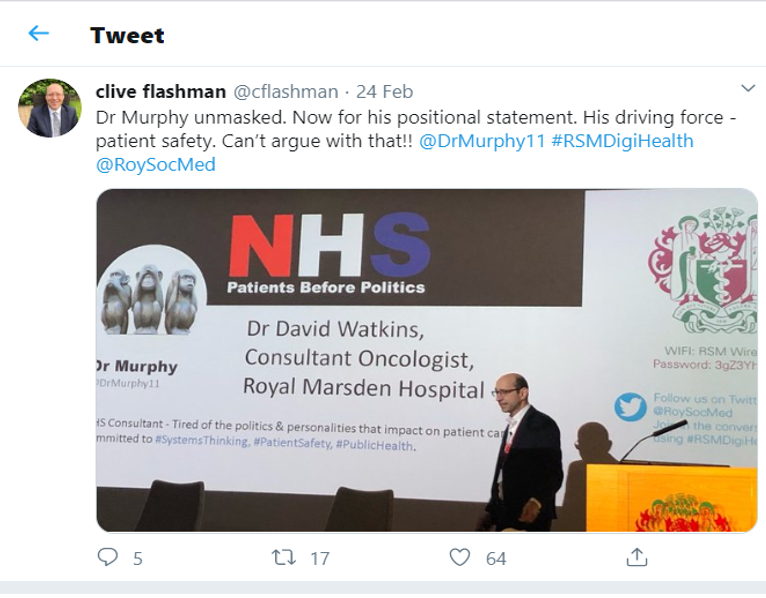
A Twitter user under the pseudonym of Dr Murphy first reached out to us back in 2018 alleging that Babylon Health’s chatbot was giving unsafe advice. Dr Murphy recently unveiled himself as Dr David Watkins and went public with his findings at The Royal Society of Medicine’s “Recent developments in AI and digital health 2020“ event.

241761787_Clivetwitter.png.0860cbf84b3d47a30045f42fcbef1136.png

Over the past couple of years, Dr Watkins has provided countless examples of the chatbot giving dangerous advice.

In a press release (PDF) on Monday, Babylon Health calls Dr Watkins a “troll” who has “targeted members of our staff, partners, clients, regulators and journalists and tweeted defamatory content about us”.

Read full story

Source: AI News, 26 February 2020

Read more
 

Only six of 200 NHS private units signed up to complaints watchdog

Just six of the English NHS’s more than 200 private patient units (PPUs) are signed up to the independent complaints adjudicator, HSJ has learned.

The figures follow the publication of the Paterson Inquiry earlier this month. The inquiry’s report warned patients treated in private units, including PPUs, which are not regulated by the Independent Sector Complaints Adjudication Service (ISCAS) “will not have access to independent investigation or adjudication of their complaint”.

ISCAS is the main independent adjudicator for the private healthcare sector and takes on approximately 125 adjudications each year on unresolved patient complaints. Most standalone independent providers have signed up to the watchdog. However, ISCAS membership is not mandatory and it is concerned patients wishing to complain about care at PPUs will have little choice but to pursue costly legal action. 

The government is now considering the inquiry’s recommendation that all private patients are given the right to a mandatory independent resolution of their complaint.

Read full story

Source: HSJ, 26 February 2020 

Read more
 

Hundreds of social care residents allegedly sexually assaulted, watchdog reveals

Hundreds of elderly and vulnerable social care residents have allegedly been sexually assaulted in just three months, a shock new report from the care regulator has revealed.

According to the Care Quality Commission there were 899 sexual incidents reported by social care homes between March and May 2018. Almost half were categorised as sexual assault. In 16% of the cases members of staff or visiting workers were accused of carrying out the abuse.

The watchdog said it was notified of 47 cases of rape and told The Independent local authorities were informed and 37 cases were referred to police for investigation.

Kate Terroni, Chief Inspector of adult social care at the regulator, said: “Supporting people as individuals means considering all aspects of a person’s needs, including sexuality and relationships. However, our report also shows all too starkly the other side of this – the times when people are harmed in the very place they should be kept safe. This is utterly devastating, both for the people directly affected and their loved ones."

“It is not good enough to put this issue in a ‘too difficult to discuss’ box. It is particularly because these topics are sensitive and complex that they should not be ignored.”

Read full story

Source: The Independent, 27 February 2020

Read more
 

Young people put at risk by delays for treatment

More than 70 children and young people have been put at risk by long delays in treatment by mental health services in Kent and Medway, HSJ has learned.

According to a response to a Freedom of Information request submitted by HSJ, 205 harm reviews have been carried out for patients waiting for treatment following a referral to the North East London Foundation Trust, which runs the child and adolescent mental health services in Kent and Medway.

Of those, 76 patients, who had all waited longer than the 18 week target time for treatment, were found to be at risk of harm. One patient had to be seen immediately as they were judged to be at “severe” risk. Seven were found to be at “moderate” risk and 68 at “low” risk. 

The trust said “risk” meant a risk of harm to themselves or others. But it said none of the 76 patients had come to actual harm. 

Read full story (paywalled)

Source: HSJ, 25 February 2020

Read more
 

Prisoners suffer cancelled appointments and poorer healthcare

Prisoners in Britain frequently have hospital appointments cancelled and receive less healthcare than the general public, a new study has found.

As many as 4 in 10 hospital appointments made for a prisoner were cancelled or missed in 2017–18, with missed appointments costing the NHS £2 million.

The in-depth analysis of prison healthcare by the Nuffield Trust think tank examined 110,000 hospital records from 112 prisons in England. It revealed 56 prisoners gave birth during their prison stay, with six prisoners giving birth either in prison or on their way to hospital.

The Nuffield Trust said its findings raised concerns about how prisoners are able to access hospital care after a cut in the number of frontline prison staff and a rising prison population.

Lead author Dr Miranda Davies, a senior fellow at the Nuffield Trust, said: “The punishment of being in prison should not extend to curbing people’s rights to healthcare. Yet our analysis suggests that prisoners are missing out on potentially vital treatment and are experiencing many more cancelled appointments than non-prisoners.”

Read full story

Source: The Independent, 26 February 2020

Read more
 

'Corridor nursing' becoming norm in packed A&Es, warn medics

A&E units are so overcrowded that growing numbers of patients have to be looked after in hospital corridors, warn nurses and doctors.

There are rising concerns that the “shameful” trend means people stuck in corridors are not getting the care they need, or they may be even coming to harm. A&E health professionals say “corridor nursing” is becoming increasingly widespread as emergency departments become too full to look after the sheer number of people seeking treatment.

In a survey of 1,174 A&E nurses in the Royal College of Nursing’s (RCN) Emergency Care Association, 73% of those polled said they looked after patients in a “non-designated area” such as corridors every day and another 16% said they did so at least once a week, while 90% said they feared patient safety was being put at risk by those needing care having to spend time in areas of hospitals which did not have medical equipment or call bells.

Staff have had difficulty administering urgent doses of intravenous antibiotics to such patients, some of whom have been denied privacy and found it harder to use a toilet or been left in distress, nurses said.

Read full story

Source: The Guardian, 26 February 2020

Read more
 

Coronavirus: UK patients face 'random' tests to check spread

Tests for coronavirus are being increased to include people displaying flu-like symptoms at 11 hospitals and 100 GP surgeries across the UK.

The tests will provide an "early warning" if the virus is spreading, Public Health England Medical Director Prof Paul Cosford said.

Up to now, people were tested only if they displayed symptoms having recently returned from one of the countries where there has been an outbreak, including China, South Korea and northern Italy. However, Prof Cosford said Public Health England was now working with hospitals and GP surgeries to conduct "random" tests.

These will target some patients with coughs, fevers or shortness of breath, regardless of whether they have travelled to a place where the virus is spreading.

"If we do get to the position of a more widespread infection across the country, then it will give us early warning that's happening," said Prof Cosford.

Read full story

Source: BBC News, 26 February 2020

Read more
 

BMA must continue to oppose assisted suicide

The British Medical Association (BMA) should not allow itself to become a campaign tool for vested interest groups seeking a dangerous change in the law, writes Dr Matthew Davis in the Guardian.

"Doctors have a responsibility to first do no harm... Even when it may feel uncomfortable, doctors must continue to exercise their Hippocratic duty", says Dr Davies.

"The BMA must remain opposed to assisted suicide if the medical profession it claims to represent is to have any credibility in safe, caring and trustworthy expertise. It must not allow itself to become a campaign tool for vested interest groups seeking an extreme and dangerous change in the law that has, even very recently, been rejected by parliament."

Read full story

Source: The Guardian, 25 February 2020

Read more
×
  • Create New...

Important Information

We have placed cookies on your device to help make this website better. You can adjust your cookie settings, otherwise we'll assume you're okay to continue.