
Jump to content
  • articles
    9,853
  • comments
    83
  • views
    12,495,001

Contributors to this article

About this News

Articles in the news


BAME nursing staff experiencing greater PPE shortages despite COVID-19 risk warnings

Amid warnings that BAME nursing staff may be disproportionately affected by the COVID-19 pandemic, a Royal College of Nursing (RCN) survey reveals that they are more likely to struggle to secure adequate personal protective equipment (PPE) while at work.

The latest RCN member-wide survey shows that for nursing staff working in high-risk environments (including intensive and critical care units), only 43% of respondents from a BAME background said they had enough eye and face protection equipment. This is in stark contrast to 66% of white British nursing staff.

There were also disparities in access to fluid-repellent gowns and in cases of nursing staff being asked to re-use single-use PPE items.

The survey found similar gaps for those working in non-high-risk environments. Meanwhile, staff reported differences in PPE training, with 40% of BAME respondents saying they had not had training compared with just 31% of white British respondents.

Nearly a quarter of BAME nursing staff said they had no confidence that their employer is doing enough to protect them from COVID-19, compared with only 11% of white British respondents.

Dame Donna Kinnair, RCN Chief Executive & General Secretary, said: “It is simply unacceptable that we are in a situation where BAME nursing staff are less protected than other nursing staff.

Read full story

Source: Royal College of Nursing, 27 May 2020
Read more
 

BAME NHS workers could be given roles reducing risk from coronavirus under new guidance

NHS staff from black, Asian and minority ethnic (BAME) backgrounds should be “risk-assessed” and possibly moved away from patient-facing roles during the coronavirus crisis, according to official guidance.

A letter from NHS England acknowledges UK data showing these workers are being “disproportionately affected by Covid-19” and urges health trusts to make “appropriate arrangements”.

Public Health England has been asked to look into the issue by the Department of Health, the letter from NHS chief executive Sir Simon Stevens and chief operating officer Amanda Pritchard said.

“In advance of their report and guidance, on a precautionary basis we recommend employers should risk assess staff at a potentially greater risk and make appropriate arrangements accordingly,” he added.

This could mean BAME health workers being relocated away from patient-facing roles or ensuring they are adequately fitted with personal protective equipment (PPE).

Read full story

Source: The Independent, 30 April 2020

Read more
 

BAME groups hit hard again as Covid second wave grips UK nations

One of the earliest signs that black, Asian and minority ethnic (BAME) people were being disproportionately harmed by the coronavirus pandemic came when the Intensive Care National Audit and Research Centre (ICNAR) published research in early April showing that 35% of almost 2,000 Covid patients in intensive care units in England, Wales and Northern Ireland were non-white.

A lot has happened in the intervening six months with numerous reports, including by the Office for National Statistics and Public Health England (PHE), confirming the increased risk to ethnic minorities and recommendations published on how to mitigate that risk. However, as the second wave intensifies, the demographics of those most seriously affected remain remarkably similar.

ICNARC figures show that the non-white proportion of the 10,877 Covid patients admitted to intensive care up to 31 August was 33.9% in England, Wales and Northern Ireland. This rises to 38.3% of patients admitted since 1 September, albeit of a much smaller cohort (527 intensive care admissions).

The government mantra “we’re all in this together” proved to be little more than an empty rallying cry early in the pandemic and the ICNARC figures show it remains the case that people in the most deprived socioeconomic groups make up a greater proportion of patients in critical care.

Read full story

Source: The Guardian, 9 October 2020

Read more
 

BAME doctors 'still waiting for risk checks'

Many doctors from black, Asian and minority ethnic backgrounds say key risk assessments have still not taken place, or have not been acted on.

About 40% of UK doctors in the UK are from BAME backgrounds, yet 95% of the medics who have died from coronavirus were from minority backgrounds.

The NHS said last June that its trusts should offer risk assessments to staff, but hundreds told a poll for BBC News that they were still awaiting assessments or action.

Of 2,000 doctors who responded, 328 said their risks hadn't been assessed at all, while 519 said they had had a risk assessment but no action had been taken. Another 658 said some action had been taken, with just 383 reporting their risks had been considered in detail and action put into place to mitigate them.

One of those who responded was Dr Temi Olonisakin, a junior doctor in London who has Type 1 diabetes. She had her risk assessment early on in the pandemic.

"It was as comprehensive as a side A4 paper can be," she says. "I think for a lot of people it felt more like a tick-box exercise, and one that could be used to say: 'We've done what we need to do to make people feel safe' - but I'm not sure in reality that's how people felt."

Read full story

Source: BBC News, 26 March 2021

Read more
 

BAME Britons still lack protection from Covid, says doctors' chief

A third of coronavirus patients in intensive care are from black, Asian and minority ethnic backgrounds, prompting the head of the British Medical Association to warn that government inaction will be responsible for further disproportionate deaths.

Chaand Nagpaul, the BMA Council chair, was the first public figure to call for an inquiry into whether and why there was a disparity between BAME and white people in Britain in terms of how they were being affected by the pandemic, in April.

Subsequent studies, including a Public Health England (PHE) analysis in early June, confirmed people of certain ethnicities were at greater risk but Nagpaul said no remedial action had been taken by the government.

Nagpaul told the Guardian: “We are continuing to see BAME people suffering disproportionately in terms of intensive care admissions so not acting means that we’re not protecting our vulnerable communities. Action was needed back in July and it’s certainly needed now more than ever.

“As the infection rate rises, there’s no reason to believe that the BAME population will not suffer again because no action has been taken to protect them. They are still at higher risk of serious ill health and dying.”

Read full story

Source: The Guardian, 20 September 2020

Read more
 

Backlog of long cancer waits has doubled

The backlog of patients who have been waiting for cancer treatment for more than 104 days has more than doubled since last year, according to internal NHS England papers seen by HSJ.

At the start of February, the backlog of cases already at more than 15 weeks had hit 6,109, compared to 3,000 at the same point in 2020.

National targets state cancer patients should be treated with 62 days of being referred.

In the North West region, the backlog has nearly tripled over the same time period, from 289 to 831 (see regional breakdown below). Senior sources told HSJ the increase had been largely driven by acute providers in Greater Manchester and Merseyside.

Cases in which patients have to wait more than 104 days for treatment are generally considered serious breaches, and typically trigger a process to identify if the delay has caused harm to the patient. Some local systems have declared a “zero tolerance” for such instances. The data in the papers is provisional.

Michelle Mitchell, Cancer Research UK’s chief executive, said the impact of covid-19 on cancer patients has been “devastating”. She added: “The government must urgently make sure the NHS gets the funding it needs to increase cancer service capacity, and give every person with cancer the timely diagnosis and treatment they deserve.”

Read full story (paywalled)

Source: HSJ, 13 February 2021

Read more
 

Babylon Health lashes out at doctor who raised AI chatbot safety concerns

Controversial healthcare app maker Babylon Health has criticised the doctor who first raised concerns about the safety of their AI chatbot.

Babylon Health’s chatbot is available in the company’s GP at Hand app, a digital healthcare solution championed by health secretary Matt Hancock. The chatbot aims to reduce the burden on GPs and A&E departments by automating the triage process to determine whether someone can treat themselves at home, should book an online or in-person GP appointment, or go straight to a hospital.

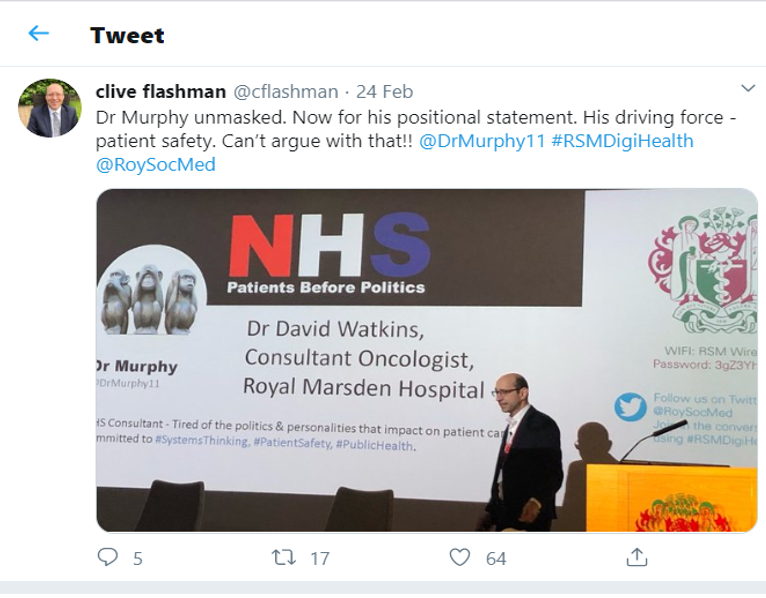
A Twitter user under the pseudonym of Dr Murphy first reached out to us back in 2018 alleging that Babylon Health’s chatbot was giving unsafe advice. Dr Murphy recently unveiled himself as Dr David Watkins and went public with his findings at The Royal Society of Medicine’s “Recent developments in AI and digital health 2020“ event.

241761787_Clivetwitter.png.0860cbf84b3d47a30045f42fcbef1136.png

Over the past couple of years, Dr Watkins has provided countless examples of the chatbot giving dangerous advice.

In a press release (PDF) on Monday, Babylon Health calls Dr Watkins a “troll” who has “targeted members of our staff, partners, clients, regulators and journalists and tweeted defamatory content about us”.

Read full story

Source: AI News, 26 February 2020

Read more
 

Babylon apology after GP app lets patients see other people's consultations

Babylon Health is investigating whether NHS patients were among those affected by a 'software error' that allowed people registered with its private GP service to view recordings of other people's consultations earlier this month.

Babylon Health has confirmed that a small number of patients were able to view recordings of other patients' consultations earlier this week. The issue came to light after a patient in Leeds who had access to the Babylon app through a private health insurance plan with Bupa reported that he had been able to view around 50 consultations that were not his own.

The patient told the BBC he was 'shocked' to discover the data breach. "You don't expect to see anything like that when you're using a trusted app," he said. "It's shocking to see such a monumental error has been made."

Babylon told GPonline that the app used by private and NHS patients is the same, but it had yet to confirm whether the roughly 80,000 patients registered with the company's digital first NHS service GP at Hand were among those affected.

The problem is understood to have cropped up when a new feature was introduced for patients who switched from audio to video mid-way through a consultation.

Read full story

Source: GPOnline, 10 June 2020

Read more

Baby’s death linked to EPR disruption

A trust has linked the stillbirth of a baby to the disruption that followed the launch of an electronic patient record.

A report to Sheffield Teaching Hospitals Foundation Trust’s board said that in September, reduced “oversight” in its Jessop Wing maternity unit meant a woman in labour was not triaged within the recommended time.

An initial assessment – itself delayed – when she arrived, found a normal heartbeat, but by the time she was re-examined, no heartbeat could be detected, the paper said. It was later discovered the umbilical cord had become entangled around the baby’s body.

Read full story (paywalled)

Source: HSJ, 8 December 2025

Read more

Baby's inquest finds serious hospital failures after family's £250k battle

A coroner has found neglect and failure to provide adequate medical care contributed to the preventable death of a baby.

Hayden Nguyen died aged six days at the Chelsea and Westminster Hospital in London in 2016.

The conclusion came after his parents spent seven years and £250,000 fighting for justice.

In a statement, the hospital said it was "committed to learning from any findings to improve our practices".

Senior Coroner Richard Travers said in his findings that Hayden had "obvious needs that were simply not met" by clinicians when his parents took him to the Chelsea and Westminster Hospital in west London in August 2016.

They were concerned about a fever he had but his condition quickly deteriorated. He had a cardiac arrest and died within 12 hours of arriving at the hospital. The treatment Hayden received, Mr Travers found, fell "very seriously below expected standards" and had he received appropriate and timely care, he would have survived.

An internal investigation by the hospital following Hayden's death found there had been eight errors in the care he'd received, including failures to identify signs of septic shock and to act on abnormal test results.

However, the original inquest into Hayden's death, held at Westminster Coroner's Court in 2017, concluded he had died of natural causes.

The coroner, Dr Shirley Radcliffe, had contacted the hospital to raise concerns about their investigation.

The hospital produced a second report, which halved the number of errors found and said the root cause of Hayden's death was an infection "which is known to have a high mortality".

Read full story

Source: BBC News, 6 December 2024

Read more
 

Baby with heart condition dies from mould exposure at hospital after open heart surgery

A baby with a serious heart condition has died after she received an infection from mould in a Seattle hospital's operating room, her mother says. 

Elizabeth Hutt was born with a heart condition that she battled for the entirety of her six-month-long life. The young child underwent three open heart surgeries, and after the third one is when it's believed she contracted an Aspergillus mould infection in the hospital's operating room. 

The mould in the hospital's operating rooms was first detected in November, around the same time as the child's third surgery. 

It was later determined the infection was contracted from the mould discovered in three of the 14 operating rooms at the hospital in November. The mould came from the hospital's air-handling units in the operating rooms, and 14 patients have developed infections from the mould since 2001, the hospital revealed. Seven of those 14 children have since died from their infections. 

Elizabeth's parents have joined a class action suit against Seattle Children's Hospital in January, which alleges facility managers knew about the mould since 2005 and failed to fix the problem. 

Read full story

Source: The Independent, 14 February 2020


Read more

Baby slings unsafe for hands-free feeding, charities warn

Childbirth charities are warning parents that hands-free breastfeeding or bottle feeding, when a baby is being carried in a sling, is unsafe.

The National Childbirth Trust (NCT) and the Lullaby Trust say the risks are highest for premature babies and those under four months old because their airways can be easily blocked.

Their updated guidance follows an inquest into the death of a six-week-old boy who was being breastfed in a baby carrier while his mother moved around their home.

The baby, Jimmy Alderman, from London, was being breastfed in a sling in October 2023, but was in an unsafe position too far down the sling and lost consciousness after five minutes, the coroner found.

A coroner's report to prevent future deaths like his found there was very little information on safe positioning of babies in slings or the risks of suffocation when feeding.

Senior coroner for west London, Lydia Brown, issued a warning, external about the dangers of baby slings following an inquest held last year into his death.

She said there appeared to be no helpful visual images of "safe" versus "unsafe" postures for babies in slings or carriers, adding that "the NHS available literature provides no guidance or advice".

The NCT said it "immediately reviewed" its online information on baby slings and carriers after receiving the coroner's report and hearing feedback from Jimmy's parents.

The NCT's online advice now says: "Hands-free breastfeeding or bottle feeding, where the wearer moves around and does other jobs while the baby is feeding, is unsafe.

"This is especially true for babies under four months old. It also applies to babies born prematurely or those with a health condition."

The charity says young babies do not have strong necks and cannot lift their heads, meaning that their airway "can easily be blocked" in baby slings and carriers.

It adds that a sling's fabric or the fabric from a parent's clothes "could cause suffocation very quickly".

"If the sling or carrier is not correctly fitted and adjusted, babies can experience traumatic head injuries," the charity's advice says.

Read full story

Source: BBC News, 26 March 2025

Read more

Baby sling safety warning as experts urge better guidance for new parents

New parents require enhanced guidance on the safe use of baby slings, according to new research.

Baby sleep experts at Durham University are advocating for improved education for parents, both pre-purchase and at the point of sale.

A survey of 1,470 parents with infants under one year old revealed that nearly nine out of ten acquired their sling or carrier online.

Of these, a mere three per cent received assistance from a virtual sales assistant or chat function, highlighting a significant gap in direct support.

Researchers stress the need for more accessible and comprehensive safety information to prevent potential misuse. The survey found that even experienced parents had difficulty with positioning the baby in a sling, creating comfort for the carrier and securing the infant safely.

Unsafe use of baby slings has been linked to accidental deaths from suffocation or falls.

In 2023, six-week-old James Alderman died in a carrier during hands-free breastfeeding, leading a coroner to issue a warning.

With incorrect sling or carrier fitting, a baby’s nose or mouth can be pressed against the parent’s body or blocked by fabric. In other cases, the baby can slump down in the carrier and their windpipe can become pinched.

Read full story

Source: The Independent, 4 June 2026

Read more

Baby loss certificates introduced in England

Bereaved parents who lose a baby before 24 weeks of pregnancy in England can now receive a certificate in recognition of their loss.

Ministers say they have listened to bereaved parents who have gone through the painful experience of miscarriage.

Campaigners said they were "thrilled" that millions of families would finally get the formal acknowledgement that their baby existed.

All parents who have experienced baby loss since September 2018 can apply.

They should visit the gov.uk website - applicants must be at least 16 years old, have been living in England at the time of the loss and be one of the baby's parents or surrogate.

In Wales, there are plans to deliver a similar scheme. 

Babies who are born dead after 24 completed weeks of pregnancy are called stillbirths, and their deaths are officially registered. But this does not happen for babies who die before that stage.

Pregnancy loss or miscarriage before 24 weeks is the most common complication of pregnancy, experienced by an estimated one in five women in the UK.

Read full story

Source: BBC News, 21 February 2024

Read more
 

Baby heart death parents left waiting 14 months for answers

Grieving parents have been left waiting more than 14 months for answers about why their 12-day-old son died.

Elijah was born at Merthyr Tydfil's Prince Charles Hospital on 25 February 2022 and died after being diagnosed with enterovirus and myocarditis.

Joann and Christian Edwards said they were told they would have a report by the end of 2022, but are still waiting.

Joann and Christian, from Mountain Ash, Rhondda Cynon Taf, said they were told Elijah's myocarditis was a "one off" but subsequently read about 10 babies, including one who died, getting severe enterovirus with myocarditis across south Wales.

Public Health Wales (PHW) said Elijah's death was not being looked into as part of an investigation into this cluster of cases, as the dates were set at June 2022 to April 2023 to coincide with the enterovirus season.

But it said it would look to include Elijah's death as part of a "wider clinical investigation" of the cases.

Read full story

Source: BBC News, 15 May 2023

Read more

Baby dies of whooping cough after mother not vaccinated while pregnant

A baby whose mother was not vaccinated against whooping cough while pregnant has died after contracting the infection, the UK Health Security Agency (UKHSA) has said.

The death, which occurred between January and June 2025, is the first fatal case of whooping cough in the UK this year.

It follows government warnings about low vaccine uptake, including among children, as well as an increase in vaccine hesitancy.

None of the main childhood vaccines in England reached the uptake target of 95% last year, recent data from the health agency showed.

Whooping cough is a bacterial infection of the lungs and airways which can be fatal, particularly for babies. Eleven infants died of the illness in 2024.

Pregnant women, as well as infants and young children, are advised to get vaccinated against it. The uptake among pregnant women currently stands at 72.6%.

The UKHSA says vaccination during pregnancy, introduced in late 2012, is "key to passively protecting babies" in their first weeks of life. Infants are first offered a jab which protects against whooping cough at eight weeks old.

Read full story

Source: BBC News, 31 August 2025

Read more
 

Baby dies after ‘excessive force’ during forceps delivery

A coroner has urged ministers to revisit plans to make it possible to hold inquests into babies that are stillborn after a baby died due to “excessive force” during an attempted forceps delivery.

Senior coroner Caroline Beasley-Murray has written to the Ministry of Justice after she was forced to stop hearing evidence into the death of baby Frederick Terry, known as Freddie, who died under the care of the Mid and South Essex Hospitals Trust on 16 November, last year.

An inquest into his death was started in September where Freddie was found to have died after suffering hypovolaemic shock as a result of losing a fifth of his blood when his skull was fractured during a traumatic birth attempt. In a report on the case the coroner said: “Baby Frederick Joseph Terry was delivered by caesarean section, after a failed forceps attempted delivery on 16 November 2019 and death was confirmed after 40 minutes of resuscitation attempts."

"The evidence showed that baby Freddie's very serious scalp and brain injuries were sustained during the failed forceps attempted delivery and, but for these, baby Freddie would have survived as a perfectly formed, healthy baby."

The coroner said the injuries he sustained implied “an excessive degree of force” in the application of the forceps, which are curved metal instruments that fit around a baby’s head and are designed to help deliver the baby.

The inquest had to be stopped from hearing any more evidence because coroners are not able to investigate stillborn babies.

As part of her report, the coroner said: “It would have been helpful for there to have been, during the course of the inquest, an exploration, in the course of evidence, of the treatment and care provided to baby Freddie and his parents at the time of delivery.

"Currently there is no legislation to cover the holding of a coroner’s inquest into a stillbirth. In March 2019, the Government issued a consultation on coronial investigations of stillbirths It would be helpful for this important topic to be progressed, whatever the ultimate jurisdictional decisions.”

Read full story

Source: The Independent, 17 November 2020

Read more

Baby died two days after birth despite mum begging doctors to assess her

A two-day old baby died just days after his mother begged doctors to assess her ahead of a c-section despite her pregnancy being deemed high risk. Davi Heer-Do Naschimento was born via emergency caesarean section during the early hours of 29 September 2021, after doctors at Royal London Hospital failed to communicate crucial details during handover meetings.

An inquest at Poplar Coroners Court heard that his parents, Ruth Heer and Tiago Do Naschimento, had asked numerous times for assistance and were not seen by the obstetrics team the day before her planned caesarean. Tragically, after becoming "feverish" during the night, she was rushed into theatre with Devi sadly dying two days later.

Speaking on behalf of the family, Francesca Kohler said that there had been “multiple occasions” throughout the day when Ms Heer and her partner had called for assistance and had raised concerns, but were not attended. She had also not been seen by the obstetrics team and had not been spoken to about the upcoming caesarean section.

Read full story

Source: My London, 4 July 2022

Read more

Baby died on maternity unit months after staff warned it was unsafe

A baby died during birth because of systemic errors in one of Britain's largest NHS hospitals, months after staff had warned hospital chiefs that the maternity unit was “unsafe”, an inquest has found.

A coroner ruled that neglect by staff at Nottingham University Hospitals Trust contributed to the death of baby Wynter Andrews last year.

She was delivered by caesarean section on 15 September after significant delays. Her umbilical cord was wrapped around her neck and leg, resulting in her being starved of oxygen.

In a verdict on Wednesday, assistant coroner Laurinda Bower said Wynter would have survived if action had been taken sooner, criticising the units “unsafe culture” and warning that her death was not an isolated incident.

Wynter’s mother, Sarah Andrews, called on the health secretary, Matt Hancock, to investigate the trust’s maternity unit.

She said: “We know Wynter isn’t an isolated incident; there have been other baby deaths arising because of the trust’s systemic failings.  She was a victim of the trust’s unsafe culture and practices.”

Read full story

Source: The Independent, 7 October 2020

Read more
 

Baby died of neglect after staff turned off emergency alarm, coroner rules

Hospital neglect contributed to the death of a two month old baby after staff turned off emergency alarms, a coroner has ruled.

Louella Sheridan died at Royal Bolton Hospital in on 24 April 2022 after she was admitted with bronchiolitis to the hospital’s intensive care unit before later dying from Covid and a related heart condition.

Four alarms on a monitoring machine were silenced and then switched off before the baby collapsed in a high dependency unit, it has been found.

On Wednesday coroner John Pollard ruled neglect by staff had contributed to Louella’s death after staff switched off the alarms on the monitors attached to her during the night.

Summing up his conclusion Coroner Pollard reportedly said there was a “gross failure “ to provide basic medical care to Louell and that had care been given, had the alarms been switched on to alert staff her life may have been extended at least for a short period of time.

He said turning off the alarms was a gross type of conduct.

Read full story

Source: The Independent, 22 December 2023

Read more

Baby died of hospital infection despite ‘overcrowding’ warning

A baby died with an infection caught on a neonatal unit, despite earlier warnings about outbreaks due to its “approach to overcrowding” of cots, HSJ has learned.

The death happened at Leeds General Infirmary between December 2022 and March 2023, during an outbreak of the Serrratia healthcare-associated infection on the L43 unit.

An internal paper from March 2023 seen by HSJ refers to “the death of one neonate being directly attributed to an organism associated with cross-transmission within L43”. 

The paper also reveals that – following earlier outbreaks on the unit, including both Serrratia and Klebsiella in 2021 – experts from the UK Health Security Agency had predicted there would be more outbreaks, due to the unit’s “approach to overcrowding”.

Leeds Teaching Hospitals Trust had apparently tried to reduce the number of cots on the L43 unit in September 2022 from 34 to 22, with two additional “surge” cots.

But regional demand pressure meant it failed to keep numbers down, with an average of 26 cots occupied in December 2022 and numbers hitting 32 on some days, according to information seen by HSJ. The unit takes some of the sickest babies from across the region.

Read full story (paywalled)

Source: HSJ, 26 June 2025

Read more
 

Baby died of brain injury after midwives ‘neglected’ mum while breastfeeding

Olly Vickers died of a brain injury in February last year just weeks after two midwives at Royal Bolton Hospital let his mother Emma Clark feed him while she was having gas and air – in breach of guidelines.

Despite being well when he was born, Olly was found “pale and floppy” hours later due to his airways being obstructed. He developed a brain injury and died five months later.

Coroner Peter Sigee ruled his death was a result of “neglect” and due to a “gross failure to provide basic medical care”.

An inquest into his death heard a student midwife placed a pillow under his mother’s arm while she was feeding him, “contrary to accepted practice”.

Another midwife then gave Ms Clark gas and air while she was feeding Olly as she was stitched up for a tear obtained during labour – which again went against guidance.

No risk assessment was carried out and the coroner said Olly’s breastfeeding should have been stopped before the midwives began to suture Ms Clark.

Read full story

Source: The Independent, 8 July 2023

Read more

Baby died from sepsis after mishandled biopsy, inquest hears

A 10 day old baby died of sepsis following a biopsy after doctors gave her the wrong antibiotics, sent her home too early, and failed to get her parents’ informed consent, an inquest has heard.

Willow Rose Courtney-Thompson, who was born prematurely on 12 October 2024, had problems feeding and underwent a suction rectal biopsy at the John Radcliffe Hospital in Oxford to rule out the rare bowel condition Hirschsprung’s disease.

But an inquest heard the procedure was carried out without informed consent from her parents, Joseph and Lauren Courtney-Thompson, who were not made fully aware of its risks and benefits.

Read full story

Source: BMJ News, 25 November 2025

Read more

Baby died after NHS trust failed to warn mother of ‘unsafe’ home birth, coroner finds

A mother who lost her baby a week after an “unsafe” home birth that went against medical advice was failed by the NHS, an inquest has found.

Poppy Hope Lomas was seven days old when she died at University College hospital in London on 26 October 2022 after complications during a home birth that, according to her mother, was encouraged by midwives at Barnet hospital.

An inquest into Poppy’s death at Barnet coroner’s court concluded that she probably died from a lack of oxygen reaching her brain in the 30 minutes before she was born.

The senior coroner Andrew Walker said the Royal Free London NHS foundation trust had agreed to support Poppy’s mother, Gemma Lomas, with an “unsafe home delivery that was against medical advice” and had failed to address “an accumulation of risk factors”.

After the inquest concluded on Thursday, Lomas said outside the court: “Nothing will ever bring her back, but hearing the truth today acknowledged means everything to us.

“We trusted the professionals who were guiding us,” she said, adding that she hoped lessons would be learned.

She previously told the inquest that midwives had actively encouraged her to have a vaginal birth at home, despite the risks because she had given birth to her first daughter, Willow, by caesarean section in 2018.

Guidance from the Royal College of Obstetricians and Gynaecologists says vaginal births after caesarean (VBACs) should take place in a “suitably staffed and equipped delivery suite” and “with resources available for immediate caesarean delivery”.

“I was encouraged to do what we did,” Lomas said. “I would have never made decisions to harm myself or my baby in any capacity.”

Read full story

Source: The Guardian, 23 April 2026

Read more
 

Baby died after hospital’s ‘catalogue of failings’, NHS inquiry finds

Bristol Children’s hospital tried to ‘deceive’ Ben Condon’s parents about his death, NHS ombudsman says

An eight-week-old baby died after “a catalogue of failings” in his treatment at a children’s hospital, which then tried to “deceive” his parents about his death, an official inquiry has found.

Doctors failed to spot that Ben Condon was suffering from a deadly bacterial infection and did not give him antibiotics until an hour before he died, the NHS ombudsman said.

“We found that Ben and his family suffered serious injustice in consequence of the failings we found in his care and treatment,” the parliamentary and health service ombudsman said in a report that contained damning criticisms of Bristol Children’s hospital. The errors were all “lost opportunities” to help Ben recover from his illness and so increased the risk of him dying.

Read the full article here
Source: The Guardian
Also covered in the Independent

Read more
×
  • Create New...

Important Information

We have placed cookies on your device to help make this website better. You can adjust your cookie settings, otherwise we'll assume you're okay to continue.