


Claire Cox
Members
-
Joined
-
Last visited
Everything posted by Claire Cox
-
Content ArticleThis report, published by the Association of Anaesthetists, gives recommendations based on clinical experiences of managing patients throughout Italy. In particular, the authors describe key elements of clinical management, including: safe oxygen therapy; airway management; personal protective equipment; and non‐technical aspects of caring for patients diagnosed with coronavirus disease 2019.
-
Community PostSadly, I am not a GP.... I have tweeted this post out in the hope of getting some responses back. I think there is a real urgency for guidance and reassurance to patients about when and who to call for help from at this time. We are also seeing a reduction in the amount of people attending ED...where are the 'usual' sick patients, the GI bleeds, the strokes.....I do hope they are not dying at home.
-
Content ArticleDifficult conversations are always needed in healthcare and are important in order to offer informed choice of what treatments will be of benefit to the patient and are important to manage the expectations of patients, families and clinicians. But what is currently happening during the coronavirus pandemic in primary care? What should be best practice? Claire, a clinical outreach nurse, explores this in her latest blog.
-
Content ArticleThe ICU & Critical Care Nursing Revision is part of the Intensive Nurse blog. It has been designed and structured to assist revision and learning for anyone who is: new to intensive care units (ICU) and critical care participating in an ICU/critical care nursing program or returning due to COVID-19. This blog is part of the Free Open Access Nursing Education (#FOANed) movement which is a global collaboration utilising technology, social media and the agility to discuss relevant healthcare topics in real time.
-
Content ArticleThis teaching presentation, by Kings Hospital clinical fellows, is based on ‘Kings clinical summary guidelines’ when caring for a patient with diagnosed COVID 19 This presentation includes: Disease progression Diagnosis Bloods Imaging Radiology Guidelines Investigations Treatment Organ Support Prognosis Treatment escalation planning Palliative care PPE Resuscitation Intrahospital transfer.
-
Content ArticleThis pneumonic is for quick diagnosis / risk assess for coronavirus developed by doctors in Italy.
-
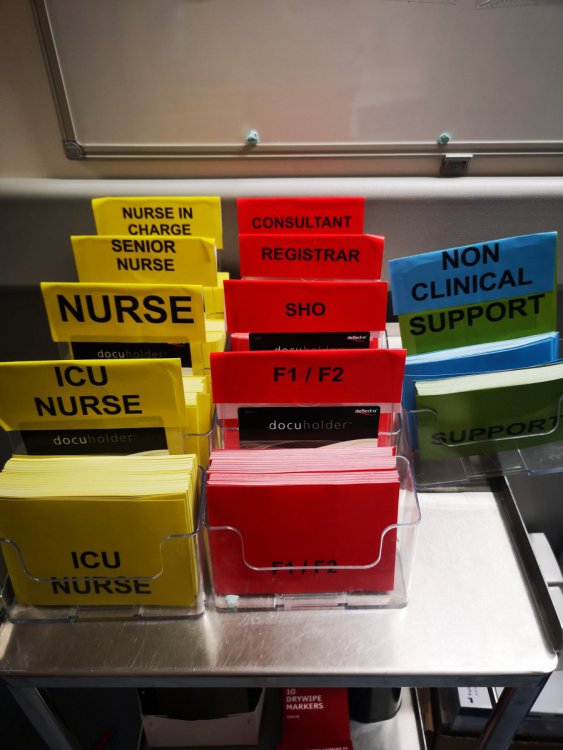
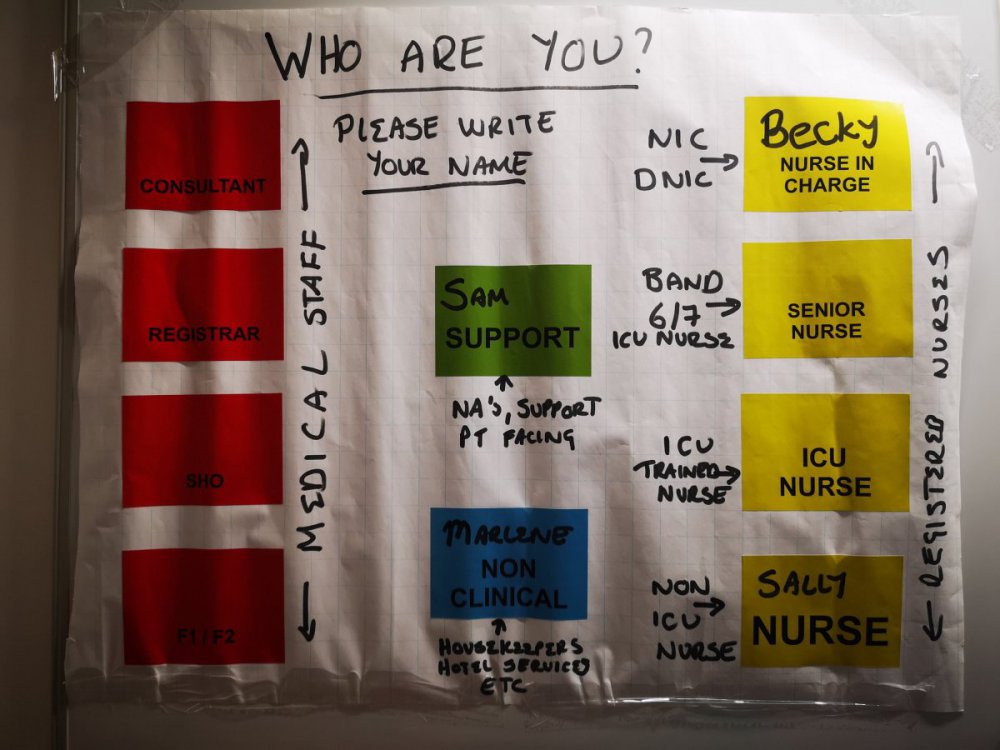
Community PostAnother one here for identifying who is who. This is from University Hospital NHS Foundation Trust
-
Content ArticlePeople with a learning disability have higher rates of morbidity and mortality than the general population and die prematurely. At least 41% of them die from respiratory conditions. They have a higher prevalence of asthma and diabetes, and of being obese or underweight in people. All these factors make them more vulnerable to coronavirus. There is evidence that people with autism also have higher rates of health problems throughout childhood, adolescence, and adulthood, and that this may result in elevated risk of early mortality. This guide, from NHS England, states the following key points should be addressed when assessing and treating a patient with a learning disability or with autism who is suspected of having or is known to have coronavirus: Be aware of diagnostic overshadowing Pay attention to healthcare passports Listen to parents/carers Make reasonable adjustments Understanding behavioural responses to illness/pain/discomfort Mental Capacity Act Ask for specialist support and advice if necessary Mental wellbeing and emotional distress. Please download the full guide for further detail.
-
Content ArticleThis article was published by Medigram, for chief medical officers and chief operating officers of hospitals and health systems to review with their infectious disease teams and chief executive officers. It looks at key lessons and strategies for preventing COVID-19 transmission within hospitals, including Personal Protective Equipment (PPE) standards, workflows, infrastructure. and workforce management. The content is based on the response to COVID-19 on South Korea.
-
Content ArticleThe emergence in December 2019 of COVID-19, caused by a novel coronavirus, and its subsequent spread around the world, led the World Health Organisation to declare a pandemic on March 11, 2020: the first to be caused by a coronavirus . The virus appears to have originated in bats, with spread to humans likely mediated by an intermediate mammalian. This paper by Dr Nicole Le Saux, discusses the current epidemiology for COVID 19 in children.
-
Content ArticleThis free course from the World Health Organization includes content on clinical management of patients with a severe acute respiratory infection. It is intended for clinicians who are working in intensive care units (ICUs) in low and middle-income countries and managing adult and paediatric patients with severe forms of acute respiratory infection (SARI), including severe pneumonia, acute respiratory distress syndrome (ARDS), sepsis and septic shock. It is a hands-on practical guide to be used by healthcare professionals involved in clinical care management during outbreaks of influenza virus (seasonal) human infection due avian influenza virus (H5N1, H7N9), MERS-CoV, COVID-19 or other emerging respiratory viral epidemics. Learning objectives: By the end of this course, participants should possess some of the necessary tools that can be used to care for the critically ill patient from hospital entry to hospital discharge. Course duration: Approximately 10 hours. Target audience: This course is intended for clinicians who are working in intensive care units (ICUs) in low and middle-income countries.
-
Content ArticleA trainee ophthalmologist shares his experience with BMJ Opinion of being redeployed to the frontline of COVID-19 preparation and hopes that it will allay fears.
-
Content ArticleMeditation has been shown to help people stress less, focus more and sleep better. Headspace is meditation made simple, teaching you life-changing mindfulness skills in just a few minutes a day.
-
Community PostGreat to hear the Brighton University Hospitals trust is buying the High viz suits today to get this role out on the wards ASAP.
-
Community PostWhat a fantastic idea. ...I am amazed at the speed that innovations are coming out. It just shows how adaptable our NHS staff can be. Given the tools and the capability - they can do anything! Are there any other innovative ideas that you have seen to keep staff and patients safe during this pandemic? We would love to know, as so would many other Trusts Claire
-
Content ArticleThe international Society for Rapid Response Systems (iSRRS) is the peak international body related to Rapid Response Teams (RRTs) and Critical Care Outreach (CCO) services around the work. The aim of the iSRRS is to improve the prevention of, and response to acute deterioration in hospitalised patients.
-
Content ArticleSpeciality guides for patient management during the coronavirus pandemic.
-
Content ArticleGuys and St Thomas' Hospital NHS Foundation Trust and the National Institute for Health research (NIHR) have developed an app. This app can be accessed by everyone. It will map out symptoms you may have (coronavirus symptoms) even if you feel well. This is part of ongoing research in how this virus is spreading and to understand symptoms.
-
Content ArticleA careful planning for a pandemic, like COVID-19, is critical to protecting the health and welfare of entire humanity. Hospitals play a very critical role within the health system in providing essential medical care to the community, particularly during the crisis. But hospitals are complicated and vulnerable institutions, dependent on crucial external support and supply lines. During the current outbreak, an interruption of these critical support services and supplies would potentially disrupt the provision of acute health care by an unprepared health-care facility. Any shortage of critical equipment and supplies could limit access to the needed care and have a direct impact on healthcare delivery and panic could potentially jeopardise established working routines. In such scenario, even a modest rise in admission volume can overwhelm a hospital beyond its functional reserve. Even for a well-prepared hospital, coping with the health consequences of a COVID-19 outbreak would be a complex challenge for sure. WHO hospital readiness checklist shows the key actions to take in the context of a continuous hospital emergency preparedness process.
-
Content ArticleThis document should be used to guide clinicians on the appropriate use of continuous positive airway pressure (CPAP), non-invasive ventilation (NIV), here referring to bilevel positive airway pressure (BiPAP) and high flow nasal oxygen (HFNO, such as OptiflowTM) in patients with confirmed or suspected COVID-19. Published evidence, clinical guidelines and personal communications with colleagues in China and Italy have informed this document. The guidance is not designed to be prescriptive but to provide a useful aid to use alongside clinical judgement. It can be adjusted to suit individual clinical environments. Decisions relating to the escalation of ventilatory support (whether as a trial of treatment, as a ceiling of care, or as a possible bridge to ongoing invasive ventilation) need to be made early and by experienced clinical decision-makers.
-
Content ArticleThe COVID-19 pandemic has led to a widespread response across the NHS in terms of how staff and the departments and organisations in which they work can help to manage the challenges being faced now and in the coming weeks and months. This includes the need to learn new skills and procedures at short notice, to rehearse the management of complex and potentially hazardous clinical cases in unfamiliar environments, and to be assured that any systems, policies and protocols that are put into action are designed to promote safe, effective care and support staff well-being. There is an important role for simulation as a technique or intervention in this set of unique circumstances, which will be implemented more effectively if integrated and aligned with the many other initiatives aimed at supporting staff and the NHS as a whole.
-
-
Community PostDuring this time of crisis our role is changing on a daily basis. I am working as an outreach nurse in Brighton. We can no longer function as a 'normal' outreach team. We are trying to do our usual role ; seeing follow up patients, seeing NEWS referrals over 5....but we are not effective. There needs to be a rethink on what our role is with in this situation. What referrals are we to take? Are escalation policies still being adhered to? How do we assess the 'red' patient safely? What happens to the follow up patients? What happens with gaps in your rotas? Please get in touch on what your teams are doing!!
-
Content ArticleIn this blog, Claire discusses the use of NEWS2 in coronavirus patients and the importance of recognising, tracking and alerting the appropriate team that your patient has an increasing oxygen demand to ensure that the risk of more people being exposed to the virus is minimal.
-
Content ArticleThis video demonstrates how to perform an intubation safely on a patient with coronavirus.


