

Summary
At the beginning of 2025 we launched our video interview series Speaking up for patient safety. The series is hosted by Peter Duffy, NHS whistleblower and Chair of the Healthcare Working Group at WhistleblowersUK, and Helen Hughes, Patient Safety Learning’s Chief Executive.
In each interview we hear from someone who has raised concerns about patient safety in healthcare, often at great cost to their own career and personal life. They share their story and their reflections on what needs to be done to improve organisational cultures so that when staff raise patient safety issues, their concerns are responded to appropriately and not dismissed because they are inconvenient to address. Alongside the thread of bravery and tenacity that runs through each contributor, a number of common themes come up time and again as people share their experiences. In this blog, Helen and Peter look at some of these themes and outline their implications for people who speak up or whistleblow.
Content
We are now three months into the series, which seems like a good time to stop and reflect on what we have learned so far. Our introductory blog about ‘Speaking up for patient safety’ explains why we launched the series and what we hope it will achieve. It also explains in more detail what we mean when we talk about speaking up and whistleblowing. Briefly, speaking up in healthcare is when a member of staff raises concerns about something that is worrying them to a manager or someone else within, or outside of, their organisation. In some cases—but not all—when someone speaks up, it is also defined as ‘whistleblowing’. Whistleblowing always involves a concern that is in the public interest and might relate to a criminal offence, health and safety risks, failures to carry out legal obligations, a miscarriage of justice, or an attempt to conceal and cover up any of these things.
Three key themes from the interviews so far
These are the top three recurring themes we have noticed coming up in the interviews so far. Other issues we have noticed include the lack of clarity about who should take responsibility for whistleblowing and the reality of threats and bullying, and we will continue to explore these issues going forward.
1. “I didn’t realise I was speaking up, I was just doing my job!”
Perhaps the comment we have heard most frequently is that people didn’t realise they were formally speaking up or whistleblowing—they just thought they were doing their job. Every healthcare profession has a set of professional standards which all practitioners are expected to keep to. For example, the General Medical Council (GMC) states that all doctors have a duty to take action by raising concerns if they believe patient care or safety are at risk.[1] In addition, each healthcare organisation has a code of conduct, which will include requirements for staff to be honest, open and accountable for their work.
For the interviewees we spoke to, to not raise their concerns would be a failure to fulfil their duty to both their patients and their organisation.
When people speak up, they often find themselves in the middle of a process that they had no idea they were entering. This can be very disorientating and leave them unprepared for the path ahead of them. At the end of this blog, we share some advice from our interviewees about what to do if you find yourself in this position.
2. There is a whistleblowing ‘playbook’
Most organisations have policies and support in place to listen to staff members who raise concerns, including access to a Freedom to Speak Up Guardian. We have interviewed Jayne Chidgey-Clark, the National Guardian, who described the good practice that many are developing.
However, we are hearing about several common tactics that some organisations use when dealing with people who speak up or blow the whistle.
The experiences of our interviewees suggest that these approaches may be deliberately designed to disadvantage the individual throughout the process—from investigation through to employment tribunals.
Some of the key activities we have heard about include:
- Organisations not responding—or responding at the very last minute—to communications from the staff member. Interviewees said they received emails with key information at 5pm on a Friday, which left them with no opportunity to ask questions or respond until the next working week. They expressed their belief that this may be a deliberate tactic to exert pressure on the individual speaking up, which amounts to emotional bullying.
- The use of occupational health as a way to cast doubt on the mental state of the person. Occupational health providers are often very supportive, but we are concerned that organisations are fishing for reasons to question the believability and motives of staff who speak up.
- Over-focus on HR issues, rather than focusing on the patient safety issues someone has raised.
- Mandated isolation from colleagues while investigations take place. This can have a very damaging effect on the person’s mental health as well as restricting their ability to source evidence from other staff in support of the concerns they have raised. We have heard examples of colleagues agreeing to provide supportive testimony, but then feeling pressurised to withdraw this support.
- Retaliatory referrals against the person speaking up to professional regulators, such as the General Medical Council and Nursing and Midwifery Council, which can have a detrimental effect on a healthcare professional’s reputation and career. Regulators are aware of how such referrals can be used to intimidate whistleblowers and discourage them from raising concerns. Some have approaches to ensure that fitness to practice concerns are appropriately addressed without unfairly impacting doctors who have raised whistleblowing concerns.
To highlight these tactics we have created 'The whistleblower playbook' infographic, illustrating how some organisations respond to staff raising concerns about patient safety.
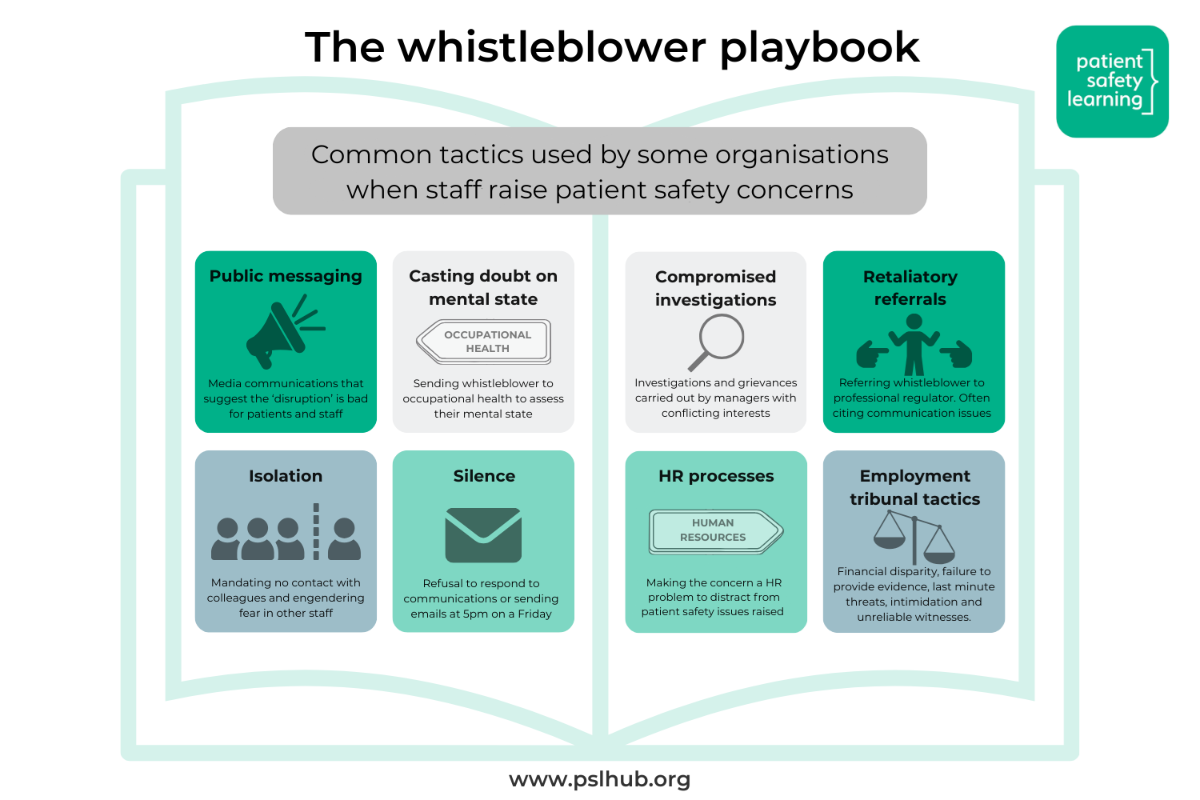
We believe it is important to identify and call out these tactics so that people raising concerns are aware of them and can seek support and advice. Organisational leaders need to look at their own practice and recognise the ethics of their approaches and whether their actions match their stated organisational values. They need to be aware of the significant damage these tactics cause to people who raise concerns and the chilling impact it might have on their organisational culture, effectively preventing others’ raising concerns.
3. Employment tribunals are unfit, unfair and imbalanced
Every person we spoke to who had attempted to pursue justice at an employment tribunal commented that the process was unfit for purpose and not the right place for whistleblowing cases to be heard. Employment tribunals take no interest in the safety issues being raised.
The main issue we keep hearing is that the tribunal system is weighted in favour of whichever side has the most financial resources—which will almost always be the employer.
A single individual who has lost their employment can rarely succeed against the millions of pounds that organisations are willing to spend on highly specialised lawyers who have tried and tested ways of winning.
The playbook we identified above also runs into employment tribunals, with whistleblowers reporting:
- The employer and their legal advisers withholding key documents, and emails, minutes, notes and other vital information going missing.
- Key witnesses, often in senior leadership positions, being unable to recall events.
- Receiving last minute threats from their former employer to come after them for costs and often being given a limited time to consider signing a non-disclosure (NDA) to settle a case. If rejected, often the NHS organisation will seek the full costs from the whistleblower, including expensive external legal costs and internal staff costs, which can amount to thousands of pounds—few whistleblowers can afford to take this financial risk, even if they and their advisers think they have a strong case.
Advice from our interviewees if you find yourself speaking up
Reflecting on their experiences, our contributors have made some observations about how you can protect yourself when speaking up, should the issue escalate.
- Try to resolve issues locally first. This is not always possible, but if a concern can be raised and dealt with within a team or with a manager, in some cases this will prevent the situation from escalating to a formal process.
- Keep a record of concerns and events as they happen. This means you will have some facts and clear observations to refer back to, if the situation does escalate.
- Don’t go to meetings alone. Take a trusted colleague with you so that every conversation is witnessed. Get your union involved if you are called to meetings about your concerns or receive counter-complaints or accusations.
Regulation of NHS managers
Some of the interviewees highlighted that regulating NHS managers may be a potential means of tackling some of these issues. The Department of Health and Social Care recently held a public consultation on proposals that could see managers who use misconduct to silence whistleblowers barred from working in the NHS.
Patient Safety Learning has formally responded to the consultation, stating that there is a clear case for the regulation of NHS managers, for the protection and benefit of both staff and patients. Everyone in healthcare should be honest and transparent when something goes wrong. Patient Safety Learning’s response expressed support for a professional register of NHS managers and the requirement for individuals in NHS leadership to have a professional duty of candour.
These measures would be a positive step in increasing accountability for healthcare organisations in how they respond to staff raising patient safety concerns. But this is only one part of a much wider set of changes needed—significant cultural change also needs to take place in tandem with these reforms. Staff across many organisations are still afraid to speak up, as indicated by the most recent NHS staff survey results.
Thank you to our contributors, and an invitation to get involved
We’d like to take this opportunity to express our gratitude again to each person who has been willing to share their experiences and insights with us—it can be very difficult to retell traumatic events that have changed the course of your life. We are also aware that there are many other individuals who have experienced unjust treatment because they have spoken up for safety. If that’s you, thank you for your commitment to standing up for safe, ethical care.
We invite everyone with experience in this area to contribute to this vital conversation. We would particularly like to hear from:
- Allied health professionals.
- Staff from Black and minority ethnic backgrounds
- Staff in non-clinical roles such as administration.
If you would like to share your story, you can:
- Contribute to our community conversation (you’ll need to sign up first).
- Comment on any hub post (you’ll need to sign up first).
You can find information about organisations that offer support and guidance for staff about speaking up and whistleblowing on the hub.
Watch the interviews
- Helené Donnelly
- Martyn Pitman
- Jayne Chidgey-Clark
- Gordon Caldwell
- Bernie Rochford
- Beatrice Fraenkel
- Chelcie Jewitt
References
- General Medical Council. Professional Standards: Raising and acting on concerns about patient safety, 13 December 2024
0 Comments
Recommended Comments
There are no comments to display.
Create an account or sign in to comment
You need to be a member in order to leave a comment
Create an account
Sign up for a new account in our community. It's easy!
Register a new accountSign in
Already have an account? Sign in here.
Sign In Now