


Clive Flashman
Administrators
-
Joined
-
Last visited
Everything posted by Clive Flashman
-
Content Article
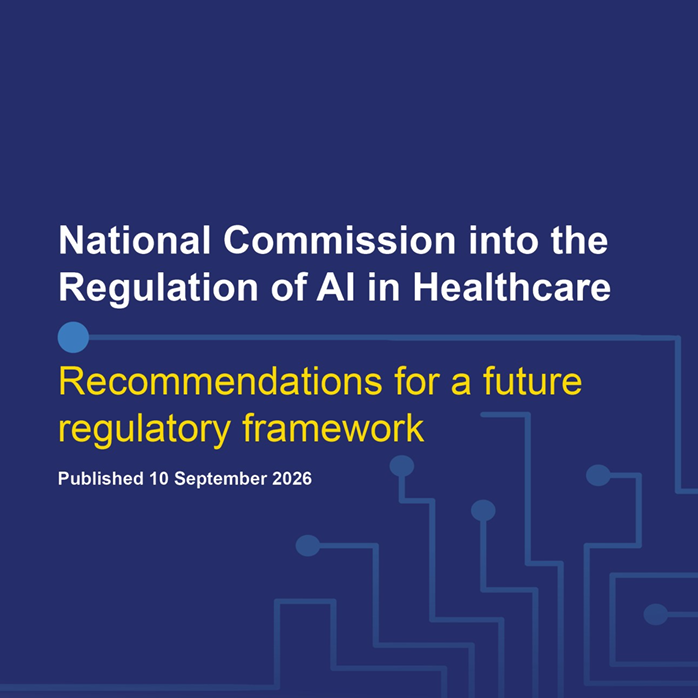 In September 2026, the National Commission into the Regulation of AI in Healthcare published its recommendations to the Medicines and Healthcare products Regulatory Agency (MHRA) for a future regulatory framework. The report contains around 44 recommendations, including staged authorisations, a rebalancing of evidence towards the post-market phase and financial penalties for manufacturers who put patients at risk. In this blog, Clive Flashman, Patient Safety Learning's Chief Digital Officer, shares his personal reflections on this. He sets out the five recommendations he most strongly supports, and five gaps that need addressing before the cross-government response is published. One of the key gaps is that the Learn from Patient Safety Events (LFPSE) service does not appear anywhere in the report's 119 pages.
 -
Event
until
Patient Safety Learning and SilverBuck are delighted to announce the first Patient Safety and AI Workshop, designed for vendors of AI systems across health and care as well as academics, researchers and others interested in this domain. Format and venue The workshop takes place in London, with capacity limited to 50 attendees. A waiting list is now open - register your interest to secure a place. This is an in-person-only event: it will not be streamed on Teams and will not be recorded for future playback, ensuring open and candid discussion under Chatham House Rules. Schedule 13:30 - Registration 14:00 - 16:30 - Workshop 16:30 - 17:30 - Networking What to expect The session will introduce Patient Safety Learning and the new Networks being established on the hub, before turning to the critical issues at the intersection of patient safety and AI, and the opportunities these technologies present for improving patient safety. It will also cover the commercial opportunities available through these new communities, especially for vendors looking to sell into the NHS and private healthcare organisations. Attendees will be asked to help shape what comes next, exploring the proposed agenda for future quarterly online round tables, and identifying what outputs this emerging community should aim to produce as it becomes active. -
Event
until
Patient Safety Learning and SilverBuck are delighted to announce the first Patient Safety and AI Workshop, designed for buyers and users of AI systems across health and care. Format and venue The workshop takes place in London, with capacity limited to 50 attendees. A waiting list is now open - register your interest to secure a place. This is an in-person-only event: it will not be streamed on Teams and will not be recorded for future playback, ensuring open and candid discussion under Chatham House Rules. Schedule 09:00 - Registration 09:30 - 12:00 - Workshop 12:00 - 13:00 - Networking What to expect The session will introduce Patient Safety Learning and the new Networks being established on the hub, before turning to the critical issues at the intersection of patient safety and AI, and the opportunities these technologies present for improving patient safety. Attendees will also help shape what comes next, exploring the proposed agenda for future quarterly online round tables, and identifying what outputs this emerging community should aim to produce as it becomes active. -
EventConfidentiality is frequently seen as a key barrier to clinicians working effectively with the family and friends of people experiencing a mental health crisis. This half day interactive course examines misconceptions about confidentiality and information sharing and offers suggestions for ways to develop your practice to offer more support and information to family and friends carers so that they are more confident about what they can reasonably do to keep their family member safe. We use the term family carers to mean anyone who is significant to the patient, including biological and non biological family and friends who may or may not live in the same household or even the same country. WHO SHOULD ATTEND This course is suitable for anyone working in Health and Social Care whose work brings them into direct contact with someone experiencing a mental health crisis. This includes psychiatrists, nurses, ED service leads, social workers, occupational therapists who have all benefitted from this training. Price: £234 More information and booking link here.
-
EventThere is a great deal of professional and statutory guidance that expects clinicians to involve the families of people during and following an acute mental health crisis. And yet, Coroner’s Prevention of Future Deaths reports, and investigations following homicides when the perpetrator had a diagnosed mental illness, regularly point to the lack of meaningful engagement of the family, the failure to listen to their views, experiences and needs, or to offer them support and information to keep their family member safe. Martha’s rule, which is to be extended to mental health services, will also require good working relationships with families. Making Families Count Life Beyond the Cubicle project was funded by NHS England (HEE South East Region legacy funds). The project’s resources were co-created with patients, family carers and clinicians, tested in eleven NHS Trusts, and independently evaluated. The resources have been shown to encourage clinicians to work well with family and friends in order to improve care, avoid harm and reduce deaths. This training is offered to support Trusts and social care agencies to embed effective working with family carers across their workforce. It is participative and interactive, and explores the key reasons clinicians find it challenging to work well with family carers, with time to share and explore good practice and share experiences of approaches taken to improve patient care and family involvement. The Life Beyond the Cubicle eLearning resources are available free to health and social care professionals via the NHS England eLearning platform. NHS Trusts can download the modules and upload them to their own Learning and Development system. WHO SHOULD ATTEND This course is suitable for anyone working in Health and Social Care whose work brings them into contact with people experiencing mental health crises, and whose role offers opportunities to facilitate group discussions and learning. Price: £354 More information and booking link here.
-
EventGood and clear communication between clinicians, patients/service users and family carers are vital for establishing and maintaining effective working relationships that can keep people who are experiencing mental health crises safe. This interactive half day course uses audio and video case studies and scenarios to explore common barriers to effective communications and what can be done about them. We use the term family carers to mean anyone who is significant to the patient, including biological and non biological family and friends who may or may not live in the same household or even the same country. WHO SHOULD ATTEND This course is suitable for anyone working in Health and Social Care whose work brings them into direct contact with someone experiencing a mental health crisis. This includes but is not limited to psychiatrists, nurses, ED service leads, social workers, occupational therapists and peer support workers. Price: £234 More information and booking link here.
-
EventGood and clear communication between clinicians, patients/service users and family carers are vital for establishing and maintaining effective working relationships that can keep people who are experiencing mental health crises safe. This interactive half day course uses audio and video case studies and scenarios to explore common barriers to effective communications and what can be done about them. We use the term family carers to mean anyone who is significant to the patient, including biological and non biological family and friends who may or may not live in the same household or even the same country. WHO SHOULD ATTEND This course is suitable for anyone working in Health and Social Care whose work brings them into direct contact with someone experiencing a mental health crisis. This includes but is not limited to psychiatrists, nurses, ED service leads, social workers, occupational therapists and peer support workers. Price: £234 More information and booking link here.
-
EventThe new NHS England guidance Staying Safe from Suicide; confirms that risk cannot and should not be measured using risk scales, and that any such scales are dangerously misleading. A more helpful and hopeful perspective is to think about the safety of people who might at times feel suicidal. This includes engaging in collaborative safety planning with patients and their family carers. This interactive half day course uses video and audio case studies to examine why safety planning is so important, and explores practical ideas about how meaningful and feasible safety planning can be carried out with family carers. Price: £234 More information and booking link here.
-
EventThe new NHS England guidance Staying Safe from Suicide; confirms that risk cannot and should not be measured using risk scales, and that any such scales are dangerously misleading. A more helpful and hopeful perspective is to think about the safety of people who might at times feel suicidal. This includes engaging in collaborative safety planning with patients and their family carers. This interactive half day course uses video and audio case studies to examine why safety planning is so important, and explores practical ideas about how meaningful and feasible safety planning can be carried out with family carers. Price: £195 & VAT (£234) More information and booking link here.
-
Event
until
Digital Health Rewired 2026 is the UK’s biggest digital health expo, bringing together everyone using digital and data to improve health and care. Held on 24-25 March at The NEC Birmingham, the event gathers NHS leaders, care providers, researchers, academics, start-ups, suppliers, and innovators to explore how digital technology supports productivity, equity, and better outcomes. With speakers, inspiring NHS case studies, and cutting-edge solutions, Rewired offers valuable learning and networking opportunities. Whether you’re shaping policy, delivering care, or building digital tools, Rewired is your chance to connect, learn, and lead in transforming health and care through digital innovation and collaboration. Register your place here. Find the full programme here. Follow updates via #Rewired26. -
Bc5f991478acf149ae653b02eabe9495This is what i would refer to as meta data. It is data about the reports (data) that have been submitted. It really tells us very little about the actual incidents - type, who was involved, where they happened, etc. Frankly, it's not very useful at all in terms of understanding the composition of incidents in England.
-
Content Article
 This blog highlights confusion and anxiety among NHS staff following the rollout of Microsoft Copilot, which many learned about only after gaining access. In the first part, a Patient Safety Manager describes their panic on discovering that Copilot could see confidential files, with little guidance provided to them on what is safe or permitted. They felt NHS advice was vague and risk-shifting, leaving staff uncertain and exposed. Patient Safety Learning's Chief Digital Officer, Clive Flashman invited wider engagement on the issue, revealing inconsistent rollouts across Trusts and a lack of clear, practical support. A LinkedIn discussion drew major attention, prompting resource sharing and calls for stronger national coordination, clearer rules, and better training to ensure safe, confident use of AI tools. In the second part of this blog, Clive offers his insights on these issues, reflects on the wider response and shares some useful links.
 -
Content ArticleA set of 5 infographics describing the the factors that influence the risk of nosocomial transmission of infections (such as Covid19), and how health and care staff can take action to manage the risks and reduce the infection rate. The factors explained are: People Equipment Task Environment Organisation
-
Content Article
 The advance of artificial intelligence (AI) has seen the emergence of digital diagnostic tools, with some claiming a more accurate diagnosis than a human. But what challenges does this present to patient safety? In this blog, Clive Flashman, Patient Safety Learning's Chief Digital Officer, looks at some of these new digital tools that are becoming increasingly available not only to clinicians but also for patients, and highlights some of the risks that they bring and considerations that need to be thought through. This blog has been published as part of a series for World Patient Safety Day 2024 and the theme of Improving diagnosis for patient safety. #WPSD24, World Patient Safety Day 2024, WPSD 2024.
 -
Bc5f991478acf149ae653b02eabe9495Clive Flashman commented on Patient_Safety_Learning's article in Digital health and care service provisionI think it's a good idea but it won't work without the infrastructure to support it and possibly a Citizen ID card. The paper seems to be regurgitating ideas from Estonia etc. without the basics in place to make it happen. If Lord Darzi advocates this within his review there will be a lot of pushback. It will cost significant chunks of money to put the 'basics' in place, which the Government can't seem to afford at the moment. The other key thing that the paper doesn't make as explicit as it should is that the Digital Health Record should be owned by THE PATIENT.
-
Community PostHi, we at patient Safety Learning are looking to hold a virtual round table in the last week of June to look at how to improve patient safety related to the implementation of EPRs. If you are a clinician who has been directly involved with the roll out of an EPR, then you could be part of the event. All notes taken at the event will follow Chatham House rules and your participation will not be disclosed outside the round table group if that is your preference. If you'd like to be involved, please contact me (Clive Flashman) directly at [email protected] Many thanks, Clive
-
Bc5f991478acf149ae653b02eabe9495and an update on this article published in the Health Service Journal today
-
Bc5f991478acf149ae653b02eabe9495Hi @Kenny Fraser, thanks for taking the time to respond. Yes, not having an EPR is definitely risky as it precludes the sharing of information, certainly within a single organisation. In terms of an assessment, I would guess that something like that was done at the beginning of the National Programme for IT back in 2003, but I've not seen anything more recently. With regard to benefits realisation, this is a useful document to look at: https://www.ouh.nhs.uk/patient-guide/documents/epr-case-study.pdf In terms of the safety reviews that EPRs have to go through, as you can imagine, they are a lot more robust than DTAC. There is an extremely detailed safety hazard assessment that was created by Dr Maureen Baker and others as part of the NPfIT roll out in the mid 2000s. That is where much of the slimmed down DCBs and DTAC material has come from. However, there are limitations to the self-assessed reviews, and there will always be 'snags' picked up post implementation. My key worry is that this 'post-market surveillance' is not sufficiently specified, or generally done, and while DCB0129 and DCB0160 are meant to be repeated also as part of this process, that hardly every happens.
-
Content Article
 NHS England recently issued a national patient safety alert to all trusts providing maternity services after faults were discovered in IT software that could pose “potential serious risks to patient safety”. In this short blog, Clive Flashman, Patient Safety Learning’s Chief Digital Officer, calls for a closer look at the reasons into this and what we can learn from it.
 -
Bc5f991478acf149ae653b02eabe9495That's great news @Chris W, would be good to share the results of that with the wider group @Patient_Safety_Learning
-
Bc5f991478acf149ae653b02eabe9495I am glad that the remit of PSPs has gone far beyond that originally envisaged by NHS E. This can only be a good thing. It would be interesting to collate this into a master job spec that can be shared across Trusts so that all can fully benefit from the input of their PSPs. Perhaps this can be done via the relevant area on this site @Claire Cox, @HelenH, @PatientSafetyLearning Team
-
Content Article
 The benefits of giving patients a central role in developing healthcare solutions have been widely demonstrated, but meaningful engagement is still far too rare, particularly in digital healthcare. In this blog for World Patient Safety Day 2023, Clive Flashman, Chief Digital Officer at Patient Safety Learning, looks at the benefits and barriers to engaging patients in developing digital healthcare solutions. He looks at why healthcare innovators struggle to include patients at an early stage of development and suggests some ways that NHS England could help facilitate coproduction through its existing patient engagement and innovation structures.
 -
Bc5f991478acf149ae653b02eabe9495If it is correct that the babies' deaths were reported into the local risk management system as medication errors, they would also have been reported onwards to the National Reporting and Learning System (NRLS); run by NHS England and all data analysed by them also. Given that these death records in the NRLS would have shown that they all occurred at the same Trust, involving babies, in the space of a 12-18 month period, I wonder whether this should have been picked up centrally?
-
Content ArticleA recent paper (from clinicians and Human Factors specialists at the Royal Surrey NHS Foundation Trust) jointly supported by Elsevier and BJA Education clarifies what Human Factors (HF) is by highlighting and redressing key myths. The learning objectives from the paper are as follows: Identify common myths around HF Describe what HF is Discuss the importance of HF specialists in healthcare Distinguish the importance of a systems-based approach and user-centred design for HF practice. It explains that HF is a scientific discipline in its own right, a complex adaptive system very much like healthcare. Its principle have been used within healthcare for decades but often in an informal way. A link to the summary of the article on Science Direct and further links to purchase the paper can be found here: https://www.sciencedirect.com/science/article/abs/pii/S2058534923000963?dgcid=author
-
Bc5f991478acf149ae653b02eabe9495Thanks Richard, it is certainly not easy as a patient to get your voice heard, but we carry on looking to improve this through the conversations we have....


