

All news
Showing .
Today
-
Content Article
 Generative artificial intelligence (AI) systems now summarise health-related search results, answer medical questions and offer guidance people once sought from clinicians. These systems bring real benefits, including plain-language explanations of medical information, around-the-clock availability and expanded access for people facing language or literacy barriers. They also carry new risks: inaccurate guidance can harm people at scale, and malicious actors can now generate personalised health misinformation at negligible cost. In this Perspective published in Nature, the authors argue that these risks are largely invisible to the institutions responsible for protecting public health. When AI guidance causes harm, no record exists outside the platform, no channel allows users to report it and no independent researcher can measure the consequences. The authors trace these invisible risks across two settings: incidental exposure online and active seeking through search engines and chatbots. Minimising harm from AI-generated health information requires making it observable. The authors therefore offer recommendations that aim to improve transparency, mitigate harm at the point of delivery and assign accountability, ranging from voluntary platform measures to regulatory ones.
 -
News article
 Maternity wards across the United States are facing a wave of closures as cuts to federal Medicaid funding take effect, experts have warned. According to analysis by the non-profit Protect Our Care, 52 maternity wards have closed since the HR1 bill was announced in July 2025, with a further eight having announced their upcoming closure. The bill, which will fully come into effect in the new year, will result in many adults covered through Medicaid having to meet new work requirements and being subject to more frequent eligibility checks, while there will be less federal funding for states for Medicaid. Hospitals which have already permanently closed their maternity wards include the Centra Southside Community hospital in Virginia and St Mary’s Sacred Heart hospital in rural north-east Georgia, which both cited upcoming federal policy changes to Medicaid as a reason. Experts are expecting to see more closures of maternity units in the run-up to and after the federal changes to Medicaid come into effect in the new year. “We’re deeply concerned that these changes already have and will continue to worsen an already serious maternity care crisis,” said Erin Jones, senior director of legislative and strategic counsel of the non-profit March of Dimes. “Reduced funding and restrictions on how states finance Medicaid will put additional pressure on state budgets and hospitals, increasing the risk that communities lose essential maternity services and specialized providers close to home.” Read full story Source: The Guardian, 11 October 2026
 -
Eee951380c62283607fe4598f2252af8Your reflection seems spot on. It would be really interesting to understand which balancing measures are being considered as part of the review of Martha’s Rule, particularly to explore any unintended consequences alongside the intended benefits.
-
News article
 Calls are continuing for a fresh investigation into the death of former UN peacekeeper Ryan Wallace. Scotland’s Patient Safety Commissioner, Karen Titchener, backs politicians who say lessons should be learned from Ryan’s death as the case raises questions about how patients with complex and unexplained illnesses are supported. The intervention comes amid growing criticism of NHS Forth Valley’s refusal to carry out a Significant Adverse Event Review following Ryan’s decision to end his life at a clinic in Switzerland on 18 August. NHS Forth Valley insists concern raised by Ryan and his family were investigated through its complaints process and later upheld by the Scottish Public Services Ombudsman. But his widow, Marianne Wallace, argues that investigation only examined events and concerns raised at that time. She said: “Their investigation did not examine the years that followed when Ryan’s health continued to deteriorate, he was given a succession of different diagnoses and treatment plans, and we felt forced to spent more than £60,000 on private healthcare as we searched for answers.” Scottish Conservative Shadow Health Secretary Miles Briggs last week called on the health board to commission an investigation voluntarily, despite there being no requirement to do so because Ryan died outside Scotland. Titchener said: “I can’t comment on the details of his care, and it isn’t my role to investigate this individual case, but his story raises questions. The whole system should want to understand what happens when someone lives for years with unexplained symptoms, conflicting diagnoses, and complex medication, and feels they need to look elsewhere for answers. “A complaint process tells us whether individual decisions were reasonable at the time. It doesn’t always tell us what we could learn from the whole journey. Learning shouldn’t stop because a complaint has been closed.” Read full story Source: The Sunday Post, 11 October 2026
 -
News article
 A GP who entered incorrect data while completing death certifications will be suspended for 10 months, a fitness-to-practise tribunal has ruled. At the time of the events that led to the suspension, Dr Lea Cramsie was practising as a salaried GP for a practice in Glasgow which provided care to people living in nursing homes, according to documents released by the Medical Practitioners Tribunal Service (MPTS). The MPTS said that the allegations were related to Dr Cramsie completing medical certificates of cause of death and ticking the box to confirm the deaths had been reported to the procurator fiscal ‘when she knew they had not’; this would exclude the deaths from being selected for review by the Death Certification Review Service. The documents said that the allegations related to ‘31 occasions’. In Scotland, the procurator fiscal has a duty to investigate certain deaths, such as those which are sudden, suspicious, accidental or unexplained, with specific guidance for GPs on when a death should be reported. The initial concerns were raised with the GMC on 26 June this year by the deputy medical director for primary care for NHS Greater Glasgow and Clyde. The referral to the GMC was further to a local investigation by the health board which arose from ‘concerns that had been raised around death certificate completion’. The GMC acknowledged that Dr Cramsie had described herself as ‘dealing with what she considered to be a disproportionate workload of death certificates’. The regulator submitted that Dr Cramsie’s workload ‘might provide some explanation for the misconduct’, but that the evidence from other practice members did not suggest that the workload was considered ‘unusually onerous’. Read full story Source: Pulse, 9 October 2026
 -
News article
 An ongoing potential corporate manslaughter investigation is looking into the deaths of four patients, a court has heard today. Police have been investigating allegations of neglect and mistreatment of patients on the stroke unit at Blackpool Victoria Hospital since 2018. Since then, two staff members have been jailed for poisoning patients, and a murder inquiry launched into the death of patient Valerie Kneale after a violent sexual assault. The investigation, known as Operation Bermuda, was also expanded to cover potential gross negligence or corporate manslaughter charges in 2023. In an update to Blackpool and Fylde coroner’s court, the patients were named as 86-year-old Margaret Mary Hamilton and Geoffrey Duckworth, 81-year-old Peter Whittaker, and 75-year-old Joan Walker. Detective chief inspector Mark Dickinson also told the court that the Care Quality Commission had investigated the deaths of the four patients but decided not to prosecute the trust. DCI Dickinson said Operation Bermuda was originally launched to investigate allegations that patients on the stroke ward were being sedated with the drug Zopiclone without any clinical need. DCI Dickinson said: “The investigation also identified other patients believed to have received poor care. Likewise, in the case of four patients, potential causal links were identified between the care they received and their death.” Read full story (paywalled) Source: HSJ, 9 October 2026
 -
Content Article
 Risa Mallory is a retired psychotherapist from Canada and a hub Topic leader. After a serious cardiovascular event in 2018 she became a patient advocate, collaborating with organisations across the globe. In this blog, Risa says that when patients are listened to, respected, and engaged as partners, treatment adherence becomes about collaboration rather than compliance.
 Last week
-
News article
 Lives could be saved and the public better protected against future epidemic and pandemic threats through a £33.2 million UK Government investment in vaccines against some of the world’s deadliest infectious diseases. This investment will help scientists to develop, test and deploy vaccines faster when new health threats emerge, both supporting people in low and middle-income countries (LMICs) and, in turn, protecting the UK by strengthening pandemic preparedness and improving resilience to future epidemic and pandemic threats. The programme has already demonstrated the value of investing, having supported development of the Oxford/AstraZeneca COVID-19 vaccine. This latest investment will help researchers respond more quickly to future threats. Supported by the UK Vaccine Network and delivered through Innovate UK, the funding will target diseases including Ebola, plague, Marburg, Lassa fever, Nipah virus, chikungunya and Mayaro. Eight projects will advance promising vaccines, clinical trials and technologies that can make vaccine design and manufacture faster and more effective. The new awards will build the research, clinical trial and technical capability needed to develop, test and deploy vaccines at speed. They will also help make vaccines affordable, accessible and ready for use in countries at greatest risk. Read full article. Source: Department of Health and Social Care, 8 October 2026
 -
News article
 Along-awaited review aimed at identifying “systemic changes” to Scotland’s crisis-hit maternity services has begun. The nine month-long nationwide review will examine how care can be improved for women, babies, and families across the country. The independent review is being chaired by the maternal and child health expert, Professor Christine McCourt, who is expected to submit her findings and recommendations in July 2027. The Scottish government said the review will take a “whole-system approach,” drawing on data, evidence and the direct experiences of women, families and staff at every level of care. However, some bereaved families have voiced misgivings about the scope of the review, and warned that it was in danger of becoming an “absolute insult” as a result. Read full article. Source: The Scotsman, 5 October 2026
 -
Eee951380c62283607fe4598f2252af8Thank you for the reflection. This gave me a lot to think about. One thought that stayed with me was whether off-mandate requests might actually be a signal of unmet needs elsewhere in the system. If patients and families repeatedly choose Martha's Rule for concerns it wasn't designed to address, perhaps that reflects a perception that it is the pathway most likely to result in someone listening and responding. That feels like an important insight, not just about Martha's Rule, but about the wider governance environment in which it sits.
-
Event
until
The publication of the National Commission into the Regulation of AI in Healthcare's recommendations comes at a critical time for NHS organisations looking to realise the benefits of artificial intelligence, safely and effectively. With many leaders seeking greater clarity around regulation, governance and deployment, this webinar, hosted by the NHS Alliance, will explore what the recommendations mean in practice. Key takeaways Interpret the Commission's recommendations and what this means for your organisation. Understand how to navigate the evolving AI regulatory and governance landscape. Identify practical steps to support safe, effective AI adoption and service improvement. What it will cover Takeaways from the Commission's recommendations on AI adoption. The current barriers to implementation. How regulation can enable safe and trusted AI deployment. The practical steps required to realise benefits for patients, staff and services. The opportunity to hear from our expert panel and take part in a live Q&A session. Register here. -
Content Article
 This report sets out the findings and recommendations of an independent review into prevalence and support for mental health conditions, ADHD and autism. The review, chaired by leading clinical psychologist Professor Peter Fonagy with the support of vice chairs Professor Sir Simon Wessely and Professor Gillian Baird, found that mental distress has increased substantially among children and young people. The findings show this has been driven by several factors, including social media, financial insecurity, increased uncertainty about the future, poorer sleep, and reduced feelings of connection and belonging. While referrals and diagnoses for ADHD and autism have risen significantly, the review found that population-level prevalence of these conditions appears broadly stable.
 -
Content Article
.png.e2df4a1b3b7bde0f52dc1db7ab2120db.png) This Health Services Safety Investigation Body (HSSIB) learning resource is aimed at learners with roles in healthcare safety investigation, including investigation, commissioning, oversight and involvement. By the end of this resource, you will be able to: Understand why you would use SEIPS in an investigation. Explain the elements of the SEIPS framework in their relation to a patient safety event. Justify the use of SEIPS as part of a safety investigation.
This Health Services Safety Investigation Body (HSSIB) learning resource is aimed at learners with roles in healthcare safety investigation, including investigation, commissioning, oversight and involvement. By the end of this resource, you will be able to: Understand why you would use SEIPS in an investigation. Explain the elements of the SEIPS framework in their relation to a patient safety event. Justify the use of SEIPS as part of a safety investigation. -
Community PostMany healthcare organisations are introducing Artificial Intelligence (AI) into work systems that were not designed for high levels of automation. In practice, this often means that new tools are added locally while team structures, responsibilities, interfaces, and escalation routes remain unchanged. The result can be more cognitive load, fragmented coordination, and unclear ownership rather than safer care. A safer approach is to redesign the work system itself: the teams, tasks, technologies, and governance that shape day-to-day clinical work. One practical step is to model team structures and work processes explicitly so that roles, interfaces, risks, and control measures are visible, traceable, and reusable. This can also provide a structured basis for Large Language Models (LLMs) to support governance tasks such as incident summaries, handover drafts, and training scenarios, all under human oversight. In healthcare, the question is not whether Artificial Intelligence will be used, but whether it will be introduced into work systems that are already difficult for staff to coordinate safely. When a new tool is added without clarifying responsibilities, interfaces, or decision authority, the likely result is not transformation but cognitive load: more interruptions, more workarounds, and less clarity about who should do what, when, and on what basis. That matters for patient safety because poorly aligned work systems can weaken handovers, delay escalation, and increase cognitive burden in already demanding settings. For that reason, I believe the starting point should be the work system, not the tool. Team organisation needs to be designed around the real demands of care: the patient journey, the coordination load between professions, the need for escalation, and the information required to act safely. In practical terms, that means defining clear team boundaries, explicit interface agreements between teams, and reliable modes of collaboration for shared problem-solving and specialist support. This makes accountability more transparent and reduces the risk that important tasks fall through the cracks. A useful next step is to model team structures explicitly. Using, e.g., Sparx Systems Enterprise Architect and SysML (Systems Modelling Language), it is possible to describe not only system structure but also behaviour, requirements, and team interfaces consistently. In a healthcare context, that can include teams, roles, responsibilities, decision points, escalation routes, handover dependencies, risks, and existing control measures. The value is not modelling for its own sake. The value is that operational knowledge becomes structured, reviewable and reusable across governance, training and redesign work. Once this information is modelled in a disciplined way, there is also a plausible route to safer use of Large Language Models. Rather than asking an LLM to generate advice from unstructured discussion alone, organisations can use structured models as a controlled knowledge base, the "Single-Source-Of-Truth". Under human review, that can support practical outputs such as incident summaries, handover drafts, training cases, draft requirements, and options for redesign. The important point is that the model provides consistency and traceability: users can see which role, task, interface, or risk the output is based on. In a patient safety setting, that is far more defensible than relying on text-based documents alone. This last point is an informed systems-engineering inference from structured modelling practice. My view is that healthcare organisations will get more value from AI when they first make their work systems visible. If we want safer care, we need to design for human-AI collaboration in the same disciplined way that we design for staffing, escalation, and accountability. Models will not replace professional judgment, but they can make coordination, governance, and learning more reliable. That is where the patient safety opportunity lies.
-
-
Content Article
 This strategy sets out Spain's strategic framework for strengthening patient safety over the next decade, promoting safer healthcare systems, fostering a culture of safety, and advancing patient-centred care across all levels of the health system.
 -
News article
 There is a risk of people being over-diagnosed with ADHD and autism, an official review in England has found. Experts said a rise in diagnoses over the past 25 years meant cases now appear to be outstripping the expected number in the population for some younger age groups. The review called for tougher regulation of private firms offering assessments for the NHS, saying they had concerns about quality and consistency, and a ban on advertising. It concluded economic uncertainty combined with social media was driving an increase in mental health problems among young people and said there needed to be better support in place for all conditions. It is likely to feed into government policies on everything from NHS services and benefits to support for young people who are not in education, employment or training. Read full article. Source: BBC News, 9 October 2026
 -
News article
 The World Health Organization (WHO) and partners have launched a new global roadmap to tackle hypertensive disorders of pregnancy, including pre-eclampsia, which affect millions of women every year. These disorders remain among the leading causes of death and serious illness for pregnant women and their babies, with tragic long-term impact on their families. Hypertensive disorders complicate an estimated 10–15% of pregnancies worldwide. They account for around 16% of maternal deaths globally, resulting in an estimated 42 000 deaths each year, as well as more than 500 000 stillbirths and newborn deaths. In many countries, women still lack reliable access to basic blood-pressure measurement, urine protein testing and essential medicines, including aspirin, antihypertensives and magnesium sulfate. Weak referral systems, shortages of trained health workers and limited emergency obstetric services can further delay life-saving care. Launched at the Society for Maternal-Fetal Medicine Global Conference, the Global roadmap for hypertensive disorders of pregnancy from 2026 to 2035 and beyond sets out coordinated actions across research and innovation, global clinical guidance, access to medicines and diagnostics, implementation, advocacy and accountability. The roadmap highlights a striking innovation gap between the scale of the problem and the lack of medicines specifically developed and approved by regulators for the prevention or treatment of pre-eclampsia or eclampsia. Research investment has largely focused on diagnostics, with chronic underinvestment in new preventive and treatment options. Read full article. Source: World Health Organization, 8 October 2026
 -
News article
 At least a fifth of baby deaths last year may have been preventable, with this estimate considered “a minimum”, an analysis of thousands of care reviews has concluded. The findings were set out in the latest annual report into 2025 Perinatal Mortality Review Tool investigations, published today by MBRRACE-UK. The report comes amid intense scrutiny of maternity services following the publication of the national maternity and neonatal investigation and Donna Ockenden’s Nottingham review this summer. Read full article (paywalled). Source: Health Service Journal, 9 October 2026
 -
News article
.png.04c0fcabe29371f75a48b7de2acdf48e.png) Nine digital technologies for dementia diagnosis, including AI-enabled clinical decision support, remote cognitive assessments and faster MRI scans, will undergo real-world testing in NHS settings. Diagnosis for dementia can take more than a year, with around 60% diagnosed within 18 weeks of referral. The Dementia Challenge, backed by up to £80 million through UK Research and Innovation’s (UKRI) Research and Development Missions Accelerator Programme (R&D MAP), aims to increase the proportion of people diagnosed with dementia within 18 weeks of referral to 92%. Read full article. Source: Digital Health, 8 October 2026
Nine digital technologies for dementia diagnosis, including AI-enabled clinical decision support, remote cognitive assessments and faster MRI scans, will undergo real-world testing in NHS settings. Diagnosis for dementia can take more than a year, with around 60% diagnosed within 18 weeks of referral. The Dementia Challenge, backed by up to £80 million through UK Research and Innovation’s (UKRI) Research and Development Missions Accelerator Programme (R&D MAP), aims to increase the proportion of people diagnosed with dementia within 18 weeks of referral to 92%. Read full article. Source: Digital Health, 8 October 2026 -
Content Article
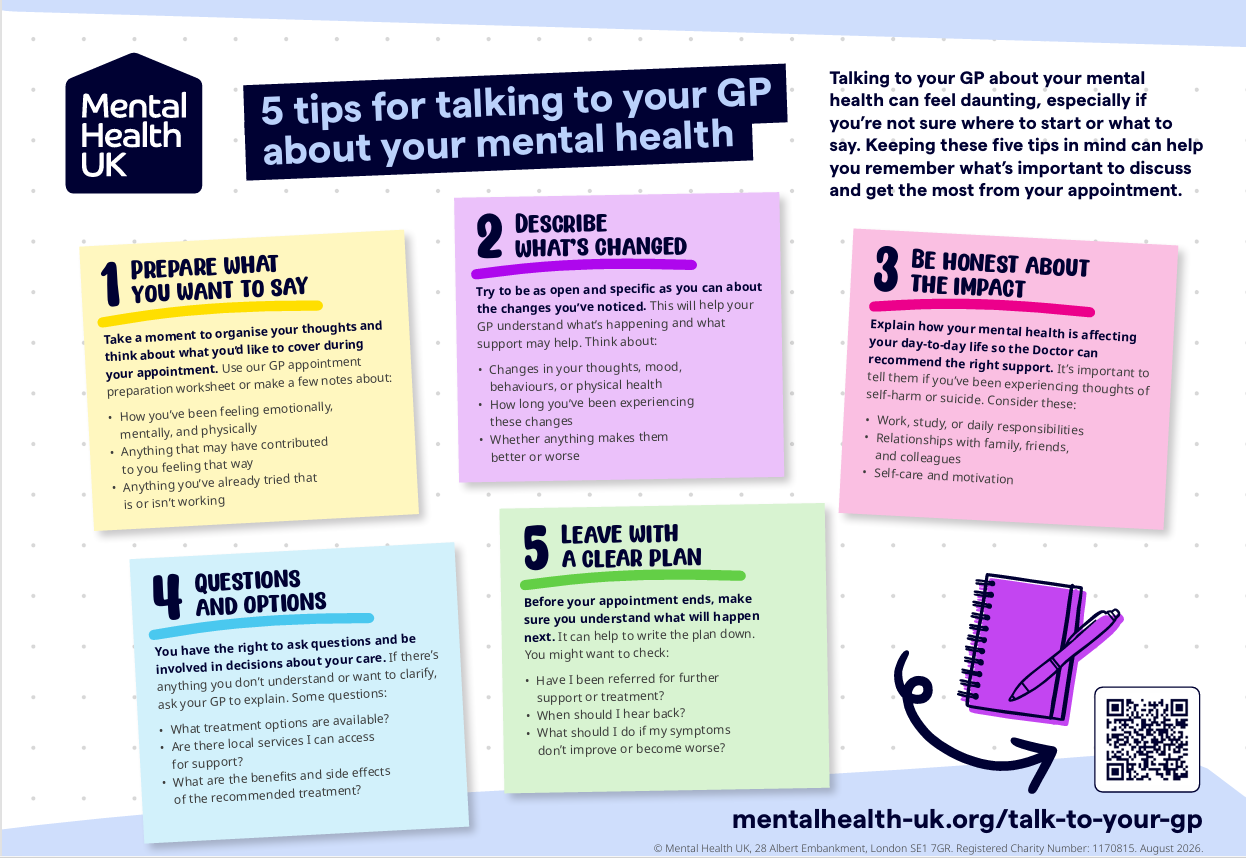 Talking to your GP about your mental health can feel daunting, especially if you’re not sure where to start or what to say. Keeping these five tips in mind can help you remember what’s important to discuss and get the most from your appointment. See further resources from Mental Health UK: free downloadable mental health resources.
 -
Eee951380c62283607fe4598f2252af8Clive Flashman commented on Clive Flashman's article in Digital health regulatory bodies/standards/guidanceThanks PJ - yes, I'm interested to see what others think too....
-
Eee951380c62283607fe4598f2252af8Przemyslaw Jaczun commented on Clive Flashman's article in Digital health regulatory bodies/standards/guidanceThank you, Clive, for sharing this. I submitted my own response, but I have never before come across anyone sharing theirs. Your point about protecting a CSO who raises a concern or withholds sign-off is the one I keep thinking of. I mentioned it only briefly in mine response to consultation but I've since been thinking of comparing the protection of a data protection officers (DPO) in relation to CSOs: under Art. 38 UK GDPR (3), a DPO cannot be dismissed or penalised for doing their job. I haven't seen that comparison discussed for CSOs, and I'm curious whether people think a similar level of protection would work here. Regards PJ
-
Eee951380c62283607fe4598f2252af8Following Julie's blog, we heard from a patient who has had similar experiences. She was happy for her story to be shared below:
-
Content Article
 When someone dies by suicide, or by a self-inflicted death, including in a psychosis, or a mental health homicide (when a person is killed by someone experiencing mental illness), it is initially called an unexplained death by the Police and it is referred to the Coroner in the area the person died. For families the processes that follow can be confusing and distressing. Trying to navigate your way through these processes at a time of profound traumatic grief can feel almost impossible. This brief guide from Making Families Count provides an overview of what might happen and signposts you to further information and sources of support.


.png.e2df4a1b3b7bde0f52dc1db7ab2120db.png)


.png.04c0fcabe29371f75a48b7de2acdf48e.png)


