


Patient Safety Learning
Administrators
-
Joined
-
Last visited
Everything posted by Patient Safety Learning
-
News article
 Government has named a chair for its public inquiry into care and governance failings at a mental health trust – nine months after the probe was promised. Judge John Potter is to lead the inquiry into Tees, Esk and Wear Valley Foundation Trust, which will examine the deaths of teenagers Christine Harnett, Nadia Shariff, and Emily Moore, who died by suicide while in the trust’s care, in 2019 and 2020. He is a retired circuit judge and former deputy judge of the Criminal Division of the Court of Appeal, with over 40 years of experience in public service, judicial leadership, and the administration of justice. He said his first priority would be to meet and “listen to those affected”, who would be “central to the inquiry’s work” and terms of reference. Its formal start date will be Monday. Lawyers and the families have called for the inquiry’s scope to include all sites run by the trust, not just West Lane Hospital, where two of the teenagers died. Read full story (paywalled) Source: HSJ, 18 September 2026
 -
Content Article
 World Patient Safety Day (WPSD 2026) offers an opportunity to rethink whose expertise shapes safer care. Learn why patients and families must be meaningfully engaged in designing care for noncommunicable diseases (NCDs) across the full journey in this blog from the Institute for Healthcare Improvement (IHI).
 -
Content Article
 Currently, around one in every ten patients globally are harmed by unintended or unexpected events during the provision of healthcare, and more than three million deaths occur annually due to unsafe care practices. In the past three years, 9.7% of British adults reported harm from NHS care or lack of access to care. To tackle this, there is ongoing work across the sector to improve safety by reducing avoidable harm and by minimising adverse events and medical errors. Thursday, 17 September marks World Patient Safety Day 2026, established by the World Health Organization (WHO) to bring together service users, providers, and governments in advocating for patient safety. To mark World Patient Safety Day, Molly Hopson, senior research associate at Picker, reflects on what available data on patient and staff experience tells us about patient safety in the NHS in England, and what the link is between patient safety and experience.
 -
News article
 Successful delivery of NHS England’s £2.5bn Frontline Productivity programme “appears to be unachievable” due to governance failures and political uncertainty, according to a government review. A review of the programme carried out by the government in July gave the programme a “red” confidence rating and concluded that “successful delivery is unlikely under the current operating arrangements”. The review, which has never been published, found that the programme’s ambition of devolving delivery to regions was undermined by “ongoing restructuring” and “the desire for greater control from the centre”. It said that achieving the programme’s aims was “predicated on a model of region-led delivery that has been overtaken by events, not least the significant reductions in capacity at regional level”, and that the model therefore requires “rapid recalibration”. In a response provided within the report, NHSE director of frontline productivity Dermot Ryan said the “red” rating was “warranted” and acknowledged the need to “reset the operating model”, but said this “falls outside my powers”. Read full story (paywalled) Source: HSJ, 16 September 2026
 -
News article
 NHS England chair Penny Dash has been criticised after suggesting that winter planning for the months ahead will be “exactly the same” as previous years, despite concerns by doctors that such planning has been ineffective. Speaking at the King’s Fund on Tuesday 8 September, Dash, who took over as chair in April 2025, said, “We are about to have a paper come to the NHS England board on winter planning. “This will be my sixth year as an NHS chair, with exactly the same paper on winter planning coming to the board. We can’t just keep going in the same way.” Dash, previously chair of North West London Integrated Care Board (ICB), continued, “We know that we’ve got 40% of people turning up at A&E [hospital emergency departments] who don’t need to be in an A&E. We’ve got over 20% of emergency admissions who don’t need to be admitted to hospital. “We’re just in groundhog day, trying to make an existing system, which is a suboptimal system, work better. So, we need to get on and do the redesign of urgent and emergency care.” Dash’s comments—which follow the NHS’s busiest summer on record—have been met with incredulity among doctors. Ian Higginson, president of the Royal College of Emergency Medicine, described Dash’s comments as an “admission of failure” and “immensely frustrating.” Meanwhile, David Oliver, a consultant in geriatrics and acute general medicine and columnist for The BMJ, questioned what Dash as chair has “personally done to address the issues instead of wringing her hands.” Oliver also pushed back on her claim that the issue lies in people coming into A&E unnecessarily. “We know that the issue with long waits and overcrowding in A&E departments is not to do with people turning up there with minor injuries and illnesses. “It is to do with patients who require admission to acute beds, because they are sick enough to need admission or because no alternative services are available for them, and there are not enough beds for them to be admitted to.” Read full story Source: BMJ, 11 September 2026
 -
News article
 The AERATOR (Aerosolisation and transmission of SARS-CoV-2 in healthcare settings) study took place during the COVID-19 pandemic. It aimed to understand whether so-called aerosol generating procedures, such as inserting a breathing tube, produced aerosols in significant numbers. AERATOR was led by anaesthetic, intensive care, infectious disease and respiratory clinicians at Southmead Hospital and aerosol scientists at the University of Bristol. The study was supported by the National Institute for Health and Care Research Biomedical Centre (NIHR BRC) Bristol. Respiratory aerosols are tiny droplets produced when people breathe, talk and cough. They are the main way respiratory infections such as COVID-19 are transmitted. The team used PLUME (Portable low-background unit for measuring exhaled aerosol), a cutting-edge device to monitor aerosol production in real time in ultraclean theatre environments usually used for orthopaedic and neurosurgery. This enabled them to study aerosols in a healthcare setting for the first time. The study found that most of the aerosol generating procedures considered high risk produced less aerosol emission than coughing or talking. Based on this and other evidence, Public Services Delivery Scotland has published updated transmission-based precautions guidance. Reflecting the latest evidence on how respiratory infections spread, the guidance introduces a more consistent, risk-based approach to infection prevention and control across Scotland’s NHS Boards, care homes and wider health and care settings. The guidance moves on from procedure-focussed risk assessment to a more holistic consideration of the type of respiratory infection, the patient’s symptoms and the healthcare professional’s exposure and own risk factors. This has effectively ended the use of the term ‘aerosol generating procedure’ in risk assessments. It will lead to a major change in how personal protective equipment (PPE) is deployed in healthcare settings. Wales has followed Scotland’s lead and adopted the same risk-based approach. Whilst the English guidelines were the first to remove some of the procedures from the original aerosol generating procedures list, they are yet to drop the list completely. Read full story Source: NHS Bristol Foundation Trust, 14 September 2026
 -
Content Article
 Richard Yates and Magdalene Plesa gave a presentation at a recent Safer Healthcare Biosafety Network meeting describing the issue of formalin and formaldehyde exposure in UK healthcare settings, with harmful side effects for healthcare workers and a lack of occupational protection or safety regulation.
 -
Content Article
 Fatal and serious harm continues to occur when patients fall from hoists or slings during transfers and repositioning. A review of recent incidents with a fatal outcome and wider surveillance data shows an average of two deaths per year since 2015.
 -
News article
 “It’s really frustrating to be in this cycle of continuous surgery. It makes you feel helpless,” says Natalie Greenwood, of a condition that affects her so badly she is “non-functioning most of the time because of the constant fatigue”. Greenwood, 36, needs to have an operation every few years to limit the impact of the endometriosis that gives her chronic pelvic pain, as well as extreme tiredness and brain fog. She says the trouble with depending on surgery is not just having an invasive procedure and then having to recover afterwards. It’s more that the benefit gained – the relief from persistent pain – is brief. She is not alone in her lack of belief in surgery and hormonal medication being effective for chronic pelvic pain. A study has found that dual approach, which is the NHS’s usual way of treating the condition, does not improve quality of life for female patients. Dr Jasmine Hearn, a reader in health psychology at Manchester Metropolitan University who co-led the research in the new study, said: “Sadly patients are often left struggling due to current pain management strategies not sufficiently alleviating pain. “Chronic pelvic pain is often invisible but its impact can be profound. Our findings highlight that women with pelvic pain report poorer quality of life when they’ve had surgery and hormonal medication for pelvic pain and better quality of life when psychological support is part of treatment.” Read full story Source: The Guardian, 15 September 2026
 -
News article
 A fourth person has died from complications related to measles in Pennsylvania, say state officials, in an outbreak that has infected hundreds of people. An 18-year-old died from acute encephalomyelitis, a rare and severe neurological complication of measles, the Mifflin County Coroner's Office in Pennsylvania said. The Keystone state has seen over 600 cases of measles this year, primarily in Lancaster County. The US eliminated measles in 2000 with the help of vaccines, but it has this year experienced the highest number of deaths from the virus since the 1990s. Last year, three people - including two children - died from a measles outbreak in Texas that spread predominantly among the Mennonite community. The rising number of cases has come as vaccine hesitancy in the US has increased in recent years, leading to lower immunisation rates. In Pennsylvania, state and local officials have said the 18-year-old and a 40-year-old, both unvaccinated, died from measles-related complications over the past month. Two infants have also died. US children typically do not receive their first MMR (measles, mumps, and rubella) vaccine until 12 months of age. Read full story Source: BBC News, 15 September 2026
 -
News article
 Researchers have warned that social media may be misleading healthy people into taking Alzheimer’s blood tests, causing severe anxiety over biological markers that may never actually cause dementia. Blood-based biomarker tests, including p-tau217 and p-tau181, detect biological signs of changes in the brain associated with Alzheimer’s disease, which is a progressive brain disorder and the leading cause of dementia. The testing looks for abnormal proteins, which can be a sign of brain changes due to Alzheimer’s. Much hope has been placed in the tests because they are often quicker and more accessible compared with other methods to diagnose Alzheimer’s, such as brain imaging or lumbar punctures. There is global consensus among peak neurological bodies, including the Alzheimer’s Association, that such tests should never be used for healthy people with no symptoms. The tests should not be used on their own to diagnose Alzheimer’s and need to be combined with other medical assessments, according to clinicians and peak bodies. Because they detect signs of Alzheimer’s early, a person can test positive for the biological markers of disease – but they may not ever go on to develop the clinical symptoms of dementia. Dr Jenna Smith from the University of Sydney’s school of public health said this has not stopped laboratories, influencers and doctors around the world from promoting the tests on social media. The researchers found more than one-third of posts promoted the tests for people without symptoms, and that accounts with explicit financial interests were more than three times as likely to do so. “The main potential harms are being unnecessarily diagnosed and not having a clear pathway for what to do next,” Smith said. Read full story Source: The Guardian, 15 September 2026
 -
News article
 Maternity and neonatal services “cannot operate on the margins” and deaths of babies and children must be investigated as a priority by boards, the health and social care secretary has warned NHS leaders. Yvette Cooper, responding to the Thirlwall Inquiry’s report, said there had been a “serious failure of governance” at the Countess of Chester Hospital which meant oversight of neonatal care had been downgraded, with only adult deaths investigated. The report recommended that all hospital trusts must have in place effective mechanisms for board-level monitoring of all deaths of children and babies by next April, and they must also have a clear route in place for staff to escalate concerning data trends or patterns. Ms Cooper told the Commons: “There is a section of the report that refers to the way senior oversight of neonatal care had been downgraded in the reorganisation of the Countess Hospital. “It includes the fact that the board and the medical director reviewed deaths within the hospital. However, it only covered adult deaths. And the report says, ‘the board did not receive any reports about the deaths of babies and children at any stage during the period the inquiry was considering. “This was a serious failure of governance which no one on the board seems to have noticed. This is further evidence of the inadequacy of the structure which removed the voice of children and babies from the board and the lack of profile of paediatrics and neonatology". Read full story (paywalled) Source: HSJ, 15 September 2026
 -
Content Article
 David Osborn, formerly a member of CATA’s Executive Team (the Covid Airborne Transmission Alliance) provides his perspective on Baroness Hallett’s Module 3 report 'Impact of the Covid-19 pandemic on Healthcare Services' to the SHBN (the Safer Healthcare Biosafety Network).
 -
Content Article
 AI is already reshaping healthcare, from ambient voice scribes in GP practices to patients self-diagnosing through large language models before they reach a clinician. But the question of whether it is making care safer or introducing new risk is not being answered clearly enough. In this session from the Connected Health & Care Summit 2026, Mark Linggood of RLDatix and Clive Flashman, Chief Digital Officer at Patient Safety Learning, hold a frank discussion on the evidence, the regulatory gaps and the role AI could play in improving incident reporting itself. Watch a candid discussion between RLDatix and Patient Safety Learning on how AI is affecting patient safety, what the research shows, where the regulatory gaps exist and how AI could transform incident reporting.
 -
News article
 Trials of an inflatable pillow developed to make moving ventilated patients lying on their front easier and safer have found it reduces the demands on ICU teams. The BathMat was created by the University of Bath and Royal United Hospitals (RUH) to be used under a prone patient's chest and abdomen to raise them. Patients lying prone have to be repositioned up to seven times a day and preliminary findings showed the device cut the number of staff needed from five to three. Dr Alexander Lunt, senior lecturer at the university said the device was inspired by ICU teams' experiences during the Covid-19 pandemic which remain relevant as they "continue to operate under significant workforce pressure". The RUH said the BathMat has been designed to free up intensive care teams, helping patients receive more consistent repositioning, "even during periods of workforce pressure". The trial, which concluded in June this year, involved 30 patients and around 160 repositioning procedures. As well as reducing the number of people needed, it was also found it saved an hour of staff time per procedure. Read full story Source: BBC News, 15 September 2026
 -
Content Article
 As part of their commitment to transparency and improvement, NHS England has published segmentation and league table figures for Quarter 1 (Q1), under the NHS oversight framework 26/27 and will continue to do so quarterly. The dashboards provide a view of how NHS trusts are performing in key services including urgent and emergency care, elective services, mental health and more.
 -
Content Article
 The Thirlwall Inquiry was set up to examine events at the Countess of Chester Hospital between 2015 and 2018 and their implications following the trial, and subsequent convictions, of former neonatal nurse Lucy Letby of murder and attempted murder of babies at the hospital. The report of the public inquiry has now been presented to Parliament.
 -
News article
 Ministers have promised sweeping changes to the NHS after a “devastating” official review concluded that three babies might have survived if hospital bosses and doctors had acted on concerns about the nurse Lucy Letby. A public inquiry found a “complete failure” to protect babies on the neonatal unit at the Countess of Chester hospital in north-west England. In a series of findings, the inquiry chair, Lady Justice Thirlwall, said two newborn twins would not have died and five others would not have been harmed if Letby had been removed from the unit sooner. Thirlwall said a third baby who died, a two-month-old girl, and two others who suffered unexplained collapses might have been protected if a doctor had detected an earlier insulin poisoning on the unit. One of those infants, now aged 11, suffered a lifelong brain injury and needs 24-hour care. Yvette Cooper, the health secretary, said she was “profoundly sorry” for the “devastating” failures revealed in the report, telling MPs: “This must be a turning point for the NHS.” She said she had asked officials to urgently take forward plans for “cot cam” monitors for neonatal units in line with Thirlwall’s recommendation. Read full story Source: The Guardian, 15 September 2026
 -
Content Article
 Although suicides and attempted suicides that happen on inpatient psychiatric units present unique challenges to patient safety, most studies in the last 25 years have focused on patient populations outside the United States, which feature different rules, practices, resources, and cultures that may influence their findings. Many of these studies also included incidents that occurred off the unit, such as when patients absconded or shortly after discharge. In contrast, this study draws attention to suicide-related events in the United States, specifically events reported in Pennsylvania from 2016 to 2025 that only occurred on the inpatient psychiatric unit. This overlooked focus provides fresh insights into the demographics, methods, objects, locations, and temporal patterns involved with on-unit suicide-related events. For example, of the 143 event reports studied, 130 (91%) were attempted suicides and 13 (9%) were suicides, and 57% involved female patients; however, 85% of the completed suicides were by male patients. Neck compression was used in 57% of cases, and suicides by this method frequently involved ligature points. Events typically occurred in private areas, such as bedrooms and bathrooms, and most occurred within the first five days of admission, from October to March, during the evening shift (3 p.m. to 11:59 p.m.). These trends reveal opportunities for further study and strategies to prevent suicide-related events on inpatient psychiatric units.
 -
Content ArticlePatient Safety Learning posted an article in Australian Commission on Safety and Quality in Health Care
 Sepsis is a time-critical emergency. Early detection and treatment are essential to preventing deaths and improving outcomes for people with sepsis and their families and carers. It is vital that sepsis continues to be addressed as a health system safety and quality priority through ongoing action. In Australia, recent analyses show the prevalence and impact of sepsis is significantly greater than previously estimated, with over 84,000 reported sepsis separations in Australian public hospitals in 2022-23. Developed as part of the Better Care Everywhere initiative, this hub supports clinicians and health service organisations to improve early detection, data quality and clinical care across the healthcare system.
 -
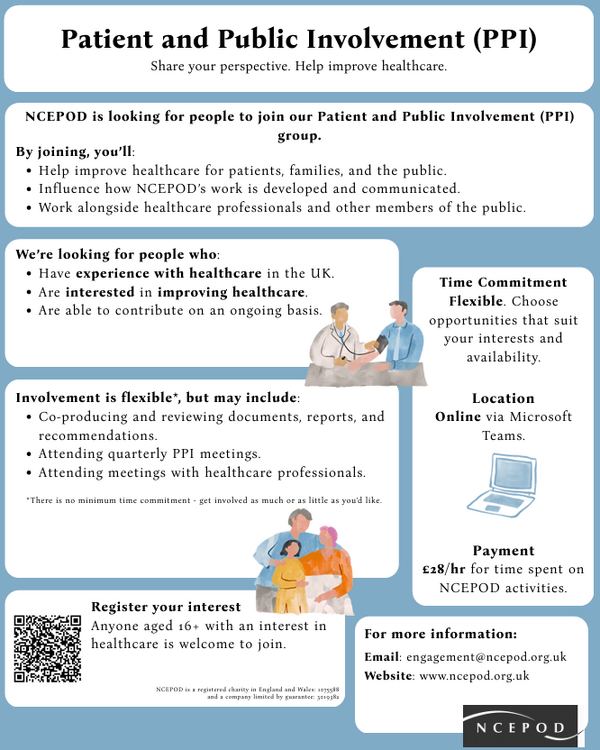
Community PostNCEPOD is looking for people to join their Patient and Public Involvement (PPI) group. Find out more information in the attachment below: Patient and Public Involvement_information pack.pdf
-
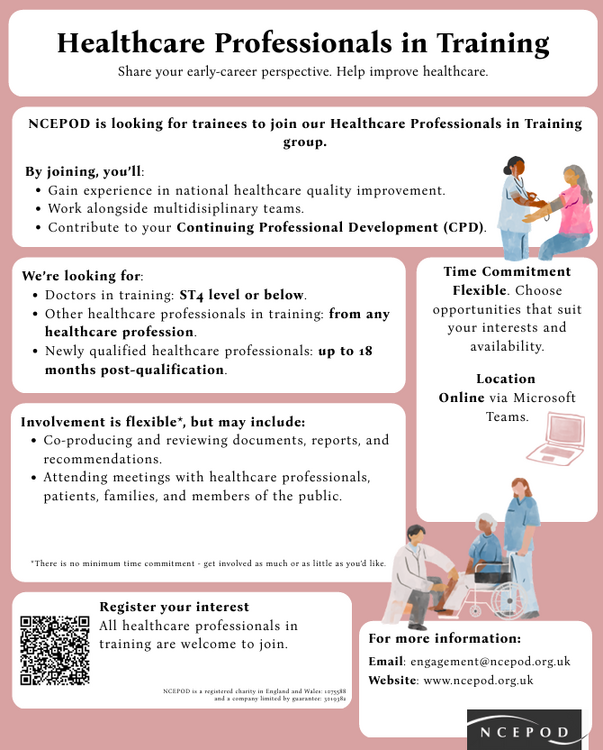
Community PostNCEPOD is looking for trainees to join their Healthcare Professionals in Training group. Further information can be found in the attachment below: Healthcare Professionals in Training_information pack.pdf
-
Content Article
 The NHS in England is facing an exodus of minority ethnic managers who have suffered racism, exclusion and discrimination during their working lives, a report from the NHS Alliance has found. Almost four-fifths of managers from black, Asian and minority ethnic (BAME) backgrounds have experienced racism, exclusion and obstacles to progressing in their careers, according to a survey carried out by the NHS Alliance. The problem is so widespread that one in five say they will quit the NHS in the next three years, amid renewed concern the service is doing too little to eradicate ingrained racism. The NHS Alliance, which surveyed 950 BAME managers, said the findings are “further evidence of the corrosive and demoralising impact of racism in the NHS”. They risk a “haemorrhaging” of managers and senior leaders from BAME backgrounds, it warned.
 -
Content Article
 NHS England has made efforts and has targeted funding towards improving A&E waiting times and patient flow through hospitals, but this growth in spending has not been matched with proportionate improvements for patients, a new report from the National Audit Office (NAO) has found.
 -
News article
 Staff falsified records, slept and were on their phones on the night one patient was killed by another on an NHS mental health unit in east London, an inquest has heard. Hugo Flint-Cahan, 34, was being treated at Newham Mental Health Centre (NMHC), run by the East London NHS Trust (ELFT), when he was fatally attacked by 22-year-old Rolando Torres-Pena. Hugo's family say they have been shocked by the "dangerous" failures in his care. The Trust says it has undertaken a significant programme of work to "improve our inpatient culture, behaviours and practice". In a narrative conclusion, the coroner found Hugo was unlawfully killed which was contributed to by neglect, recommended four members of staff be referred to their regulator and that the Metropolitan police review their investigation into what happened that night. Hugo, who had been a patient at the NHMC for six months, was strangled in the early hours of 3 January 2023 by Torres-Pena who had arrived on the ward five days earlier. A coroner criticised repeated failures by the Trust in a number of patient deaths - not just Hugo's. Graeme Irvine, the Senior Coroner for East London, said it was like "ground hog day" as he heard evidence of "the same" errors, "over and over again," including the falsification of patient observation records and slow emergency responses. Read full story Source: BBC News, 14 September 2026


