


Summary
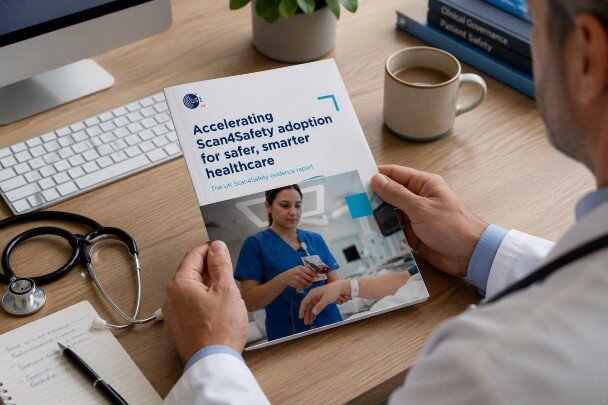
Ten years after Scan4Safety was launched, a new independent report brings together evidence of how barcode scanning and GS1 standards are supporting patient safety across healthcare.
The findings show how scanning can provide an additional check before medicines or medical devices are used. They also demonstrate how better information and inventory management can reduce manual work and return valuable time to clinical care.
In this blog, Georgina Lawton, head of healthcare at GS1 UK, reflects on what she has learned from working with healthcare organisations on Scan4Safety. She explains why successful implementation starts with a patient safety problem, rather than the technology, and why clinical involvement, senior leadership, reliable data and dedicated capacity all matter.
Content
Ten years on from the launch of Scan4Safety, we have the clearest picture yet of the difference it can make.
We have worked with healthcare organisations on Scan4Safety for much of that time. I have seen some make considerable progress, extending scanning into more departments and making it part of everyday care. I have also seen how much variation remains.
Our new evidence report, developed independently by The PSC, brings much of that experience together. It draws on research involving 29 healthcare organisations and stakeholders across the UK and Ireland, as well as international case studies and analysis of national cost data.
There is plenty in the findings to be encouraged by. But what stays with me is not one figure or case study. It is the difference reliable information can make at the point of care.
Scan4Safety uses GS1 standards to identify people, products and places consistently. When staff scan a patient identity band and a medicine or medical device, the system can provide an additional check before that product is used. It also creates a record of what was used, where, when and for whom.
Examples of Scan4Safety in practice
At Royal Papworth Hospital NHS Foundation Trust, barcode verification flagged 2,474 occasions when an incorrect patient identity band was scanned before medicine administration over two years.
That does not mean 2,474 wrong medicines would otherwise have been administered. We cannot know how many would have been identified through the checks already in place. What we do know is that scanning provided an additional layer of verification and visibility that the previous process could not offer.
At Midland Metropolitan University Hospital, we can see how this approach is developing. Scan4Safety supports Closed Loop Medicines Management across all inpatient wards. Medicines are prepared in drawers assigned to individual patients, then scanned against the patient identity band at the bedside before administration is recorded electronically.
It is a good example of technology supporting the clinical process rather than sitting alongside it. The check takes place at the point where it matters and the information becomes part of the patient’s electronic record.
Patient safety is also affected by the conditions in which people work. When clinical staff spend time searching for equipment, checking stock manually or working around incomplete information, it adds pressure and takes them away from patients.
At East Lancashire Hospitals NHS Trust, nursing staff in the emergency department had been managing stock across five storerooms and maintaining supplies for trolleys and emergency grab bags. This work amounted to 168 hours each week.
A dedicated materials management role took responsibility for replenishment, returning those nursing hours to clinical work. The trust also reported no procedure cancellations caused by missing equipment over four years.
This is not simply a stock management story. Having the right products available, in the right place and at the right time supports staff in providing safe care.
What we have learned
For me, one of the most useful findings from the research is that successful Scan4Safety programmes rarely begin with a barcode or a new system.
They begin with a problem that clinical teams want to solve.
That may be a risk during medicine administration, difficulty tracing an implant or clinical time being taken up by stock management. Beginning with the problem helps teams understand what needs to change and why scanning matters.
Clinical involvement needs to start early. Senior leadership is also important, but organisations need more than visible support. They need people with the time and authority to work through the practical detail of implementation.
The information behind the barcode matters just as much. If product data is incomplete or systems cannot share it consistently, scanning cannot deliver its full value. Organisations also need a clear starting point against which they can measure changes in safety, staff time and resources.
Technology alone will not solve these issues and national requirements have not secured consistent implementation on their own. Healthcare organisations need practical support, reliable data, connected systems and enough capacity to make lasting changes.
Ten years on, we have far more evidence and practical experience to draw on. The next step is to share what has worked and help more organisations make reliable identification and traceability part of everyday care.
That is how the evidence becomes safer care.
Read the full Scan4Safety evidence report: https://hubs.la/Q04y7Zwl0
Related reading on the hub:
About the author
Georgina Lawton is head of healthcare at GS1 UK. She works with healthcare organisations, national bodies, suppliers and technology providers to support the adoption of GS1 standards across health and care.

Recommended Comments
Create an account or sign in to comment