


Summary
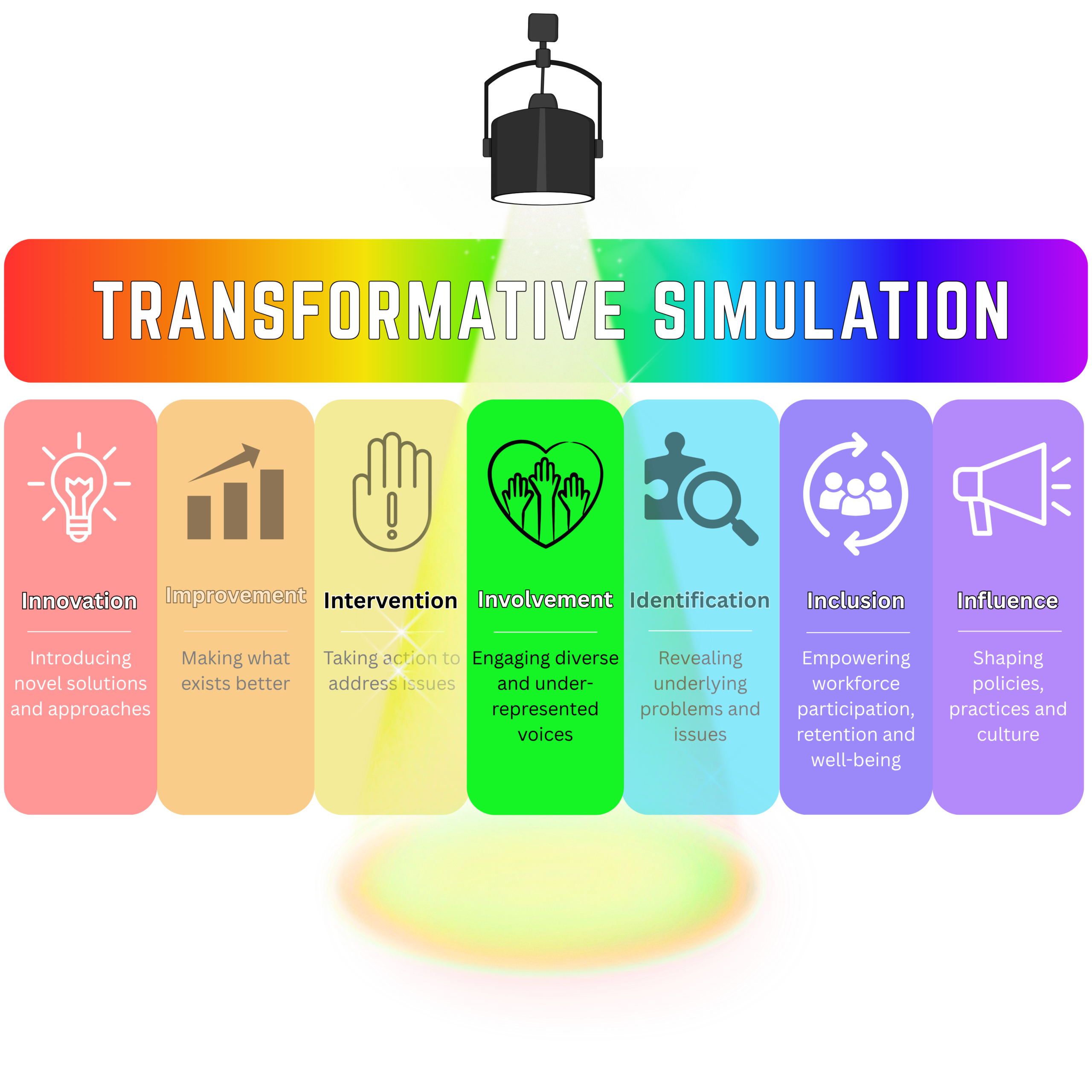
Transformative Simulation considers how simulation can be intentionally used beyond education to understand and contribute to change within healthcare systems.
The Involvement Simulation-Based Intention focuses on using simulation to structurally involve patients, carers, communities and other diverse and under-represented groups in understanding healthcare culture and systems and shaping how care is designed and delivered.
This resource from hub topic lead Sharon Weldon brings together a short Transformative Simulation thought piece, visual explainer and selected examples from the literature demonstrating how simulation has been used to bring different forms of knowledge and experience into patient safety and healthcare redesign.
Further resources from Sharon on Transformative Simulation:
Content
What is the Involvement Intention?
Patient and public involvement is increasingly recognised as essential to designing safer, more person-centred healthcare. But involvement can take many forms, and simply inviting people to participate does not necessarily change whose knowledge or perspectives shape decisions.
Within Transformative Simulation, the Involvement Simulation-Based Intention describes the purposeful use of simulation to structurally involve diverse and under-represented groups in understanding and shaping healthcare systems. Patients, carers and communities are not simply observers or recipients of professionally designed simulation; their experiences and perspectives become part of the knowledge through which the system is understood and redesigned.
The emphasis is therefore on rebalancing whose voices, experiences and knowledge carry authority within the simulation space.
This is different from co-producing a simulation scenario, consulting patients about simulation design or inviting people to attend simulation activities. These remain important considerations, but the Involvement intention asks a different question: how can simulation itself create the conditions for people who experience healthcare from different positions to collectively see, understand and shape it?
Explore the idea
The Involvement SBI: Rebalancing the Dynamics of Care explores the Involvement Intention and its roots in participatory simulation practice, including the use of simulation to rebalance traditional dynamics between patients, publics and healthcare professionals.
Drawing on more than a decade of work, it considers how approaches including Sequential Simulation and Distributed Simulation can bring patients, carers, communities, professionals and system leaders into shared enactments of care. Rather than describing healthcare through meetings or consultation alone, simulation can allow people to experience and examine the system together, making visible aspects of care that language alone may struggle to convey.
The accompanying short video provides a visual introduction to the Involvement Intention and its place within the wider Transformative Simulation framework.
Involvement in practice
Research and practice across healthcare simulation demonstrate different ways in which simulation can be used with an Involvement intention.
Examples include using simulation to:
Bring patients, carers, communities and professionals together to explore care experiences.
Centre patient and public experience when examining healthcare pathways.
Make otherwise hidden experiences of waiting, transitions, communication and fragmented care visible.
Enable diverse and under-represented voices to contribute directly to understanding and redesign.
Enact whole care pathways so that different stakeholders can develop a shared view of how the system is experienced.
Iteratively redesign care with patients, publics, professionals and system leaders rather than designing change solely from a professional perspective.
Importantly, Involvement is not simply attendance or consultation. Its defining feature is that different forms of experience and knowledge are structurally incorporated into how simulation generates insight and contributes to change.
Good examples from the literature include:
Collaborative healthcare remodelling through sequential simulation: a patient and front-line staff perspective
Demonstrates how sequential simulation brought patients, frontline staff, managers and other stakeholders together to collectively examine existing care pathways and co-design new models of integrated care.‘How to help your unwell child’: a sequential simulation project
Shows how simulation can create a shared space for local families and healthcare professionals to explore care journeys, enabling parents—including those from minority communities—to voice concerns and contribute their experiences to discussions about improving care.Demonstrates how immersive simulation and public engagement can centre people’s real-time experience of care, enabling members of the public to identify what compassionate, person-centred communication feels like and generate recommendations for healthcare practice.
Engaging patients and clinicians through simulation: rebalancing the dynamics of care
Shows how simulation-based enactment can bring patients, carers, publics and professionals together as differently expert partners, using shared experience and participatory design to shape, test and refine healthcare pathways.
From involvement to action
Simulation-Based Involvement requires more than bringing different people into the same simulation. Transformative Simulation therefore encourages teams to consider how the Involvement intention shapes each of the 4Ds: Design, Delivery, Data and Debrief.
For Involvement, this means designing simulation around whose perspectives need to be represented, delivering it in ways that enable different forms of knowledge and experience to carry meaningful weight within an intentionally designed participatory space, capturing data that reflects those multiple perspectives, and creating approaches to debriefing and interpretation in which insight is generated collectively rather than solely through a professional lens.
Questions for practice
When designing simulation for Involvement, consider:
Whose experiences and perspectives need to shape this work?
Who is currently missing or under-represented?
How will patients, carers and communities participate beyond simply being present?
What power dynamics or environments might influence whose knowledge is spoken, heard or valued?
How can the simulation create conditions in which different perspectives carry meaningful authority?
What data and insights should be captured from different participants and perspectives?
How will those involved contribute to interpreting what emerges and shaping what happens next?

Further Transformative Simulation resources on the hub:
About the author
Professor Sharon Weldon is Professor of Healthcare Simulation and Workforce Development at the University of Greenwich and President of the Association for Simulated Practice in Healthcare (ASPiH). She co-developed the Transformative Simulation framework, which brings together different ways in which simulation can be intentionally used to contribute to healthcare cultural and systems-level change. Her work focuses on healthcare simulation, patient safety, workforce development and participatory approaches to understanding and transforming healthcare systems.

Recommended Comments
Create an account or sign in to comment