


Summary
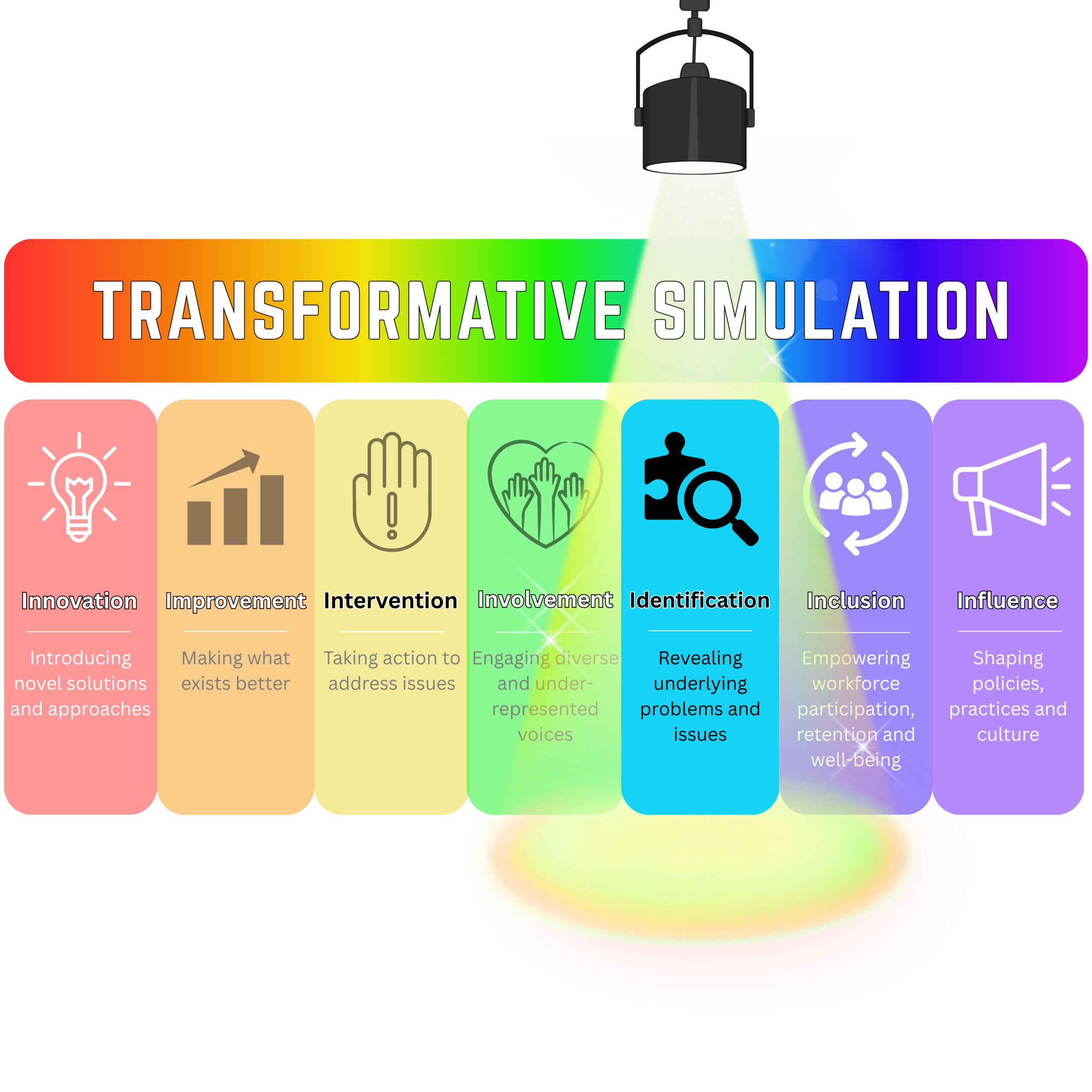
Transformative Simulation considers how simulation can be intentionally used beyond education to understand and contribute to change within healthcare systems.
The Identification Simulation-Based Intention focuses on using simulation to uncover risks, vulnerabilities, unmet needs and other aspects of healthcare systems that may otherwise remain difficult to see.
This resource from hub topic lead Sharon Weldon brings together a short Transformative Simulation thought piece, visual explainer and selected examples from the literature demonstrating how simulation has been used to identify patient safety and system challenges in practice.
Further resources from Sharon on Transformative Simulation:
Content
What is the Identification Intention?
Simulation is often associated with practising skills or assessing performance. But it can also be deliberately designed as a way of finding things out.
Within Transformative Simulation, the Identification Simulation-Based Intention describes the purposeful use of simulation to identify aspects of healthcare systems that warrant attention. These might include latent safety threats, vulnerabilities in environments or processes, gaps between work-as-imagined and work-as-done, patterns of behaviour or decision-making, or other system conditions that are difficult to observe through conventional approaches.
The emphasis is therefore not initially on fixing a predetermined problem. It is on using simulation to help us see and understand what is happening.
This distinction matters. If identification is the intention, the theories and models informing the simulation, its design and delivery, the data collected and the way findings are interpreted all need to support that purpose. Identifying latent safety threats through simulation requires more than running a realistic scenario: it requires theoretical clarity and purposeful design.
Explore the idea
Improvement & Identification: When to improve, when to identify explores the Identification Intention in greater depth, including the importance of aligning the purpose of simulation with the theories, methods and processes used to generate and interpret findings.
The accompanying short video provides a visual introduction to Identification and its place within the wider Transformative Simulation framework.
Identification in practice
Research and practice across healthcare simulation already demonstrate many ways in which simulation can be used with an Identification intention.
Examples include using simulation to:
Identify latent safety threats within clinical environments, equipment, processes and pathways.
Understand how healthcare professionals interact with complex systems under realistic conditions.
Explore discrepancies between how care is expected to operate and how work is actually accomplished.
Identify vulnerabilities before new facilities, pathways or systems become operational.
Generate insights that can subsequently inform improvement, redesign or other forms of action.
Importantly, identification and improvement are not the same intention. What is discovered through an Identification simulation may subsequently lead to improvement activity, but the immediate purpose of the simulation is to reveal, understand or characterise something about the system.
Good examples from the literature include:
Shows how in situ simulation can strengthen prospective risk assessment by revealing active failures and latent conditions that conventional approaches may leave hidden.
Highlights both the power of simulation to identify latent safety threats and the patient safety challenge that follows: ensuring identified risks are systematically acted upon and resolved.
Demonstrates how simulation before a major NICU move revealed previously unrecognised risks in routes, equipment, emergency preparedness and workflow, allowing plans to be adapted before patients were transferred.
Shows the value of testing new clinical environments before they open: simulation identified 118 latent safety threats in a new trauma setting, enabling risks to be addressed before patients entered the space.
From identification to action
Identifying a problem is only useful if there is a route for what is learned to reach the people and structures capable of responding to it. Transformative Simulation therefore encourages teams to consider from the outset how findings will be captured, interpreted, communicated and connected to subsequent action through the 4Ds: Design, Delivery, Data, Debrief.
Questions for practice
When designing simulation for Identification, consider:
What are we trying to discover or understand?
What theories or models could help us examine this effectively?
Whose perspectives are needed to understand what is happening?
What data will allow us to identify important system conditions rather than relying only on impressions from the simulation?
How will findings be captured, interpreted and communicated?
Where will responsibility sit for deciding what happens next?

Further Transformative Simulation resources on the hub:
About the author
Professor Sharon Weldon is Professor of Healthcare Simulation and Workforce Development at the University of Greenwich and President of the Association for Simulated Practice in Healthcare (ASPiH). She co-developed the Transformative Simulation framework, which brings together different ways in which simulation can be intentionally used to contribute to healthcare cultural and systems-level change. Her work focuses on healthcare simulation, patient safety, workforce development and participatory approaches to understanding and transforming healthcare systems.

Recommended Comments
Create an account or sign in to comment