


Summary
In this blog, Michele Peters, Associate Professor from the University of Oxford, shares findings from a research project that focused on patient harm in the NHS.
Content
The NHS is designed to help people get better, not make things worse. Patients reporting harm they have experienced, should help the NHS to fix the problems that really matter. However, the patient perspective of harm is scarcely researched which means an important perspective of safety in the NHS is missing.
In 2021-2022, the University of Oxford and London School of Hygiene conducted a study with 10,000 people in the UK to find out:
how often people report being harmed by the NHS
how the harm affected their health
what do people do after being harmed
what would people like after the harm.
Nb: Figures have been rounded
How many people are harmed by NHS care or by not being able to get care they need?
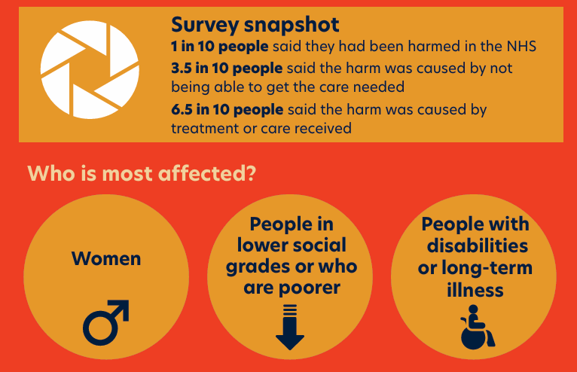
Our telephone survey asked 10,000 people in 2021 and 2022 if the NHS had harmed them physically or emotionally over the last three years. One in 10 people said they had been harmed, with some people reporting harm more often. More women (12%) than men (7%) said they were harmed. More than 3 in 10 people with disabilities or major health problems told us they had been harmed. The poorest people were more than twice as likely to be harmed than the richest people.
How did the harm affect people’s health?
Eight in 10 people reported that the harm had a serious effect on their health or life. This could be due to physical, emotional or social problems (such as affecting work).
Some people were impacted more by the harm including:
• people with long-term illness or disabilities
• people who are not working
• poorer people.
What do people do after being harmed in the NHS?
Six in 10 people went to see doctors or nurses for help after being hurt by the NHS. Some went to their GP (3.5 in 10 people) and others went back to the place where the harm happened (3 in 10 people). One in 10 people talked to the Patient Advice and Liaison Service (PALS), with about half of them feeling that this service had been helpful.
One in 5 people made a formal complaint to the NHS such as writing a letter or talking to the service where the harm had happened. Only a third of these people thought their complaint was handled well.
What would people like after the harm?
Most people just wanted care to help them get better (4 in 10 people), an explanation of what went wrong (3.5 in 10 people), or to finally get the treatment they couldn’t get before (3 in10 people). People who said they were harmed because they could not get help more often said that what they wanted most was the treatment or care they needed.
Hardly anyone (just 2 in 100 people) took legal action to get money from the NHS for what happened, with around 1 in 5 saying they didn’t want to sue the NHS or ask for money.
What does this study mean for the NHS?
This study shows how many people get harmed, and that this harm seriously affects their health and/or life. It also shows that harm can be caused by not getting the care that is needed as well as by treatment or care going wrong. Many people do not want to take legal action against the NHS or to write a formal complaint. Not many go to PALS, make a complaint, or take legal steps, but most do want support and care following harm.
Almost twice as many people reported harm in this survey, than in a previous similar survey. One reason may be because the survey took place during the COVID-19 pandemic when it was more difficult to get treatments and care as the NHS was very busy looking after Covid patients. Another reason may be because we used a more modern definition of harm. This meant we asked more directly about emotional harm and harm due to not being able to get the care or treatment they needed.
There needs to be better support for people who get harmed by the NHS, not just those hurt by medical mistakes (often determined by medical professionals rather than by patients), but also for harm that happens due to poor care planning or not being able to get treatment or care they need.
Every person harmed should receive support from the NHS to get better. Particular attention should be paid to groups of people who are harmed more often or whose health is impacted more severely by the harm.
NHS staff need better training so they can listen and demonstrate that they are taking people seriously. The NHS especially needs to focus on helping people from poorer backgrounds and those with disabilities and illnesses, who seem to be harmed more often and suffer more afterwards.
Research rarely asks patients and their families about harm but it is important to do so. If patients are not asked, a lot of harm may be unknown to the NHS. This may be especially true for emotional harm and harm due to a lack of treatment or care. If this harm remains unknown, it cannot be recorded in official NHS statistics and the NHS cannot take all the needed steps to make patients safe.
Contact Michele: [email protected]
Read the full paper: Patient-reported harm from NHS treatment or care, or the lack of access to care: a cross-sectional survey of general population prevalence, impact and responses

Recommended Comments
Create an account or sign in to comment